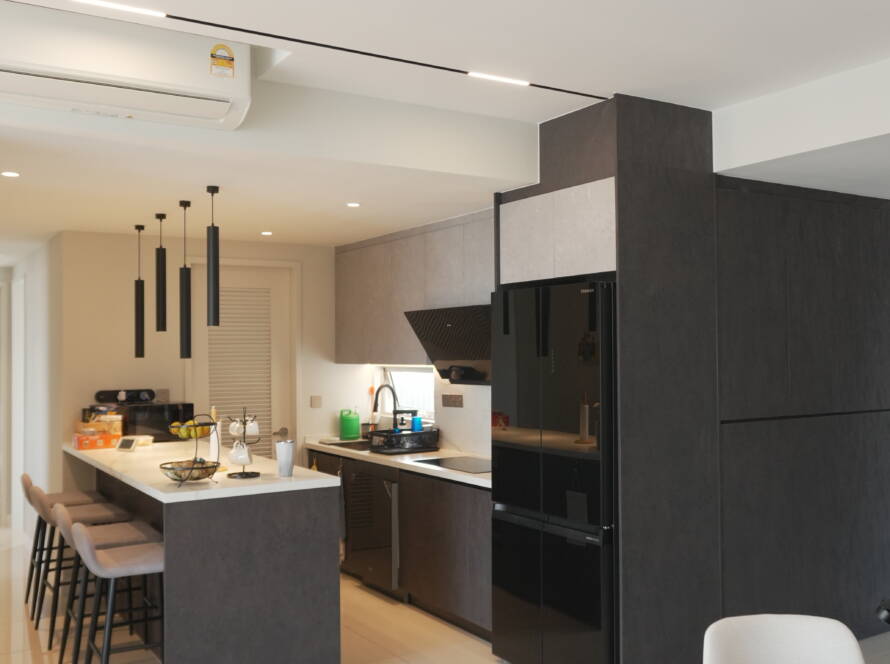
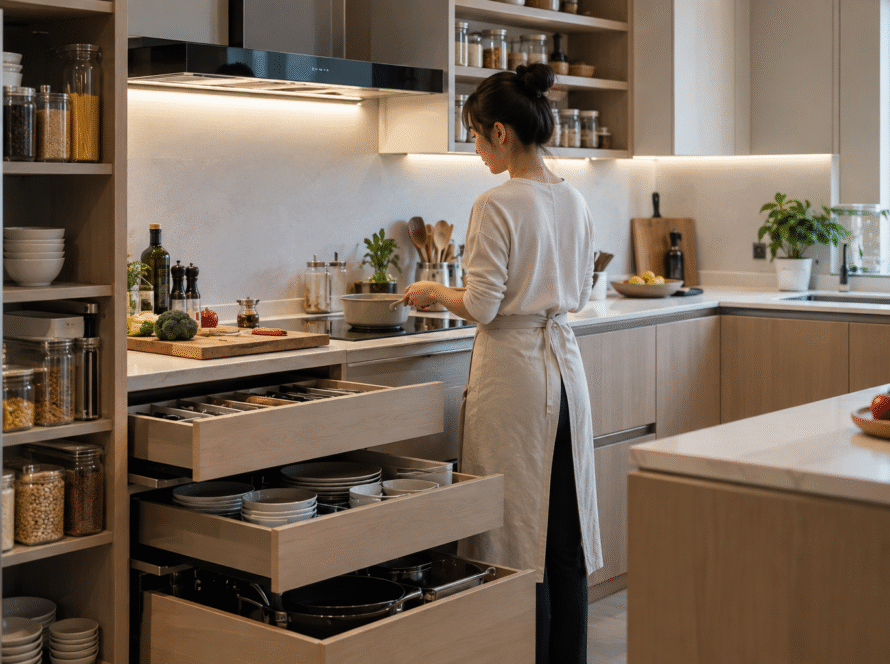
Most Malaysian homeowners spend weeks choosing cabinet colours and countertop materials — then pick their kitchen lighting in the final ten minutes. This is one of the most common renovation decisions that gets quietly regretted. Poor kitchen lighting does not just affect how the space looks. It affects how safely and comfortably you can cook, prepare food, and spend time in the kitchen every day.
This guide covers everything you need to know about kitchen lighting in Malaysia — the three types of kitchen light, how colour temperature affects your cooking environment, the right lighting for wet and dry kitchens, common mistakes, and how to plan your lighting before renovation begins.
- Every kitchen needs three layers of lighting — ambient (general), task (functional), and accent (decorative). Most Malaysian kitchens only have one.
- Under-cabinet LED task lighting is the single most impactful lighting upgrade for any kitchen — it eliminates shadow on the countertop where food preparation happens.
- Warm white (2700K–3000K) creates a comfortable, homely atmosphere in dry kitchens. Cool white (4000K–5000K) is better for wet kitchens where clarity and hygiene matter more.
- Wet kitchens need IP44-rated or higher moisture-resistant fittings — standard ceiling lights are not suitable for high-steam cooking environments.
- All lighting positions — especially under-cabinet and island pendants — must be wired before cabinet installation. Adding them after is extremely costly.
- LED is the correct choice for all Malaysian kitchen lighting — it handles heat, reduces electricity bills, and lasts significantly longer than fluorescent or halogen alternatives.
The Three Types of Kitchen Lighting Every Malaysian Kitchen Needs
A well-lit kitchen uses three distinct types of lighting working together: ambient lighting (general illumination for the whole room), task lighting (focused light for food preparation and cooking), and accent lighting (decorative light that adds depth and visual interest). Most Malaysian kitchens only have ambient lighting — which is why they feel flat or poorly lit during cooking.
Ambient lighting provides the base level of light for the entire kitchen. In Malaysian homes, this is typically ceiling-mounted downlights or panel lights. For most kitchens, a minimum of 300–500 lux is recommended for comfortable general use. Use LED downlights spaced evenly across the ceiling rather than a single central ceiling lamp — one central light creates uneven illumination and leaves corners dark. Neutral white at 4000K is the most practical choice for ambient kitchen lighting in Malaysia.
Task lighting provides concentrated, shadow-free light on specific working surfaces — countertops, the hob area, and the sink zone. Under-cabinet LED strips are the most effective task lighting solution in Malaysian kitchens: mounted beneath upper cabinets, they shine directly onto the countertop surface, eliminating the shadow your body creates when standing in front of the ambient ceiling light. Task lighting should deliver 500–800 lux on the working surface. This is non-negotiable for a kitchen that is used for regular cooking.
Accent lighting is used to highlight specific design features — glass cabinet display areas, kitchen islands, open shelving, or architectural elements. LED strip lights inside glass-fronted cabinets, pendant lights above an island, or cove lighting above full-height cabinets all fall into this category. Accent lighting is optional but significantly elevates the visual quality of a kitchen, particularly in dry kitchens that serve as a design focal point in open-plan living areas.
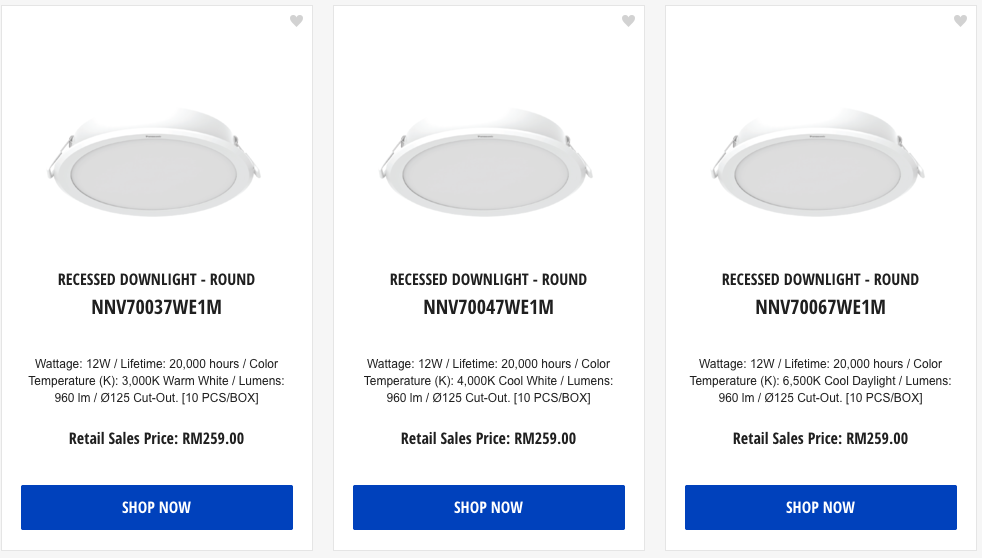
Warm White vs Cool White: Which Colour Temperature Is Right for Your Kitchen?
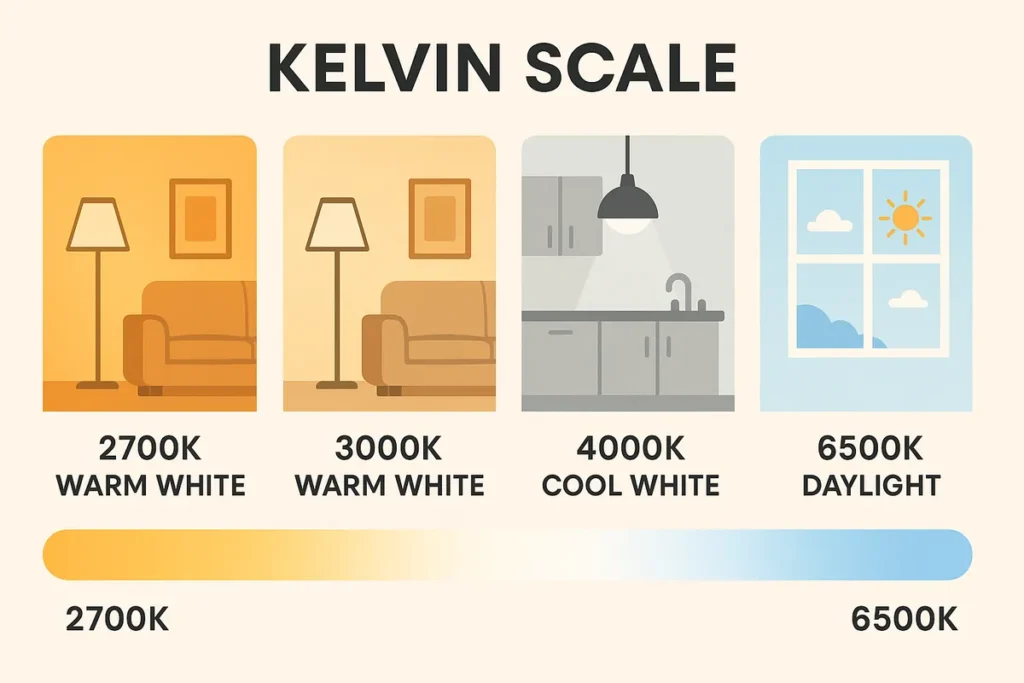
Colour temperature measures the perceived warmth or coolness of a light source, expressed in Kelvin (K). Lower Kelvin values (2700K–3000K) produce warm, yellowish light similar to candlelight or incandescent bulbs. Higher Kelvin values (4000K–6500K) produce cooler, bluish-white light similar to daylight. In kitchen lighting, colour temperature affects both the visual atmosphere of the space and the practical clarity of the working environment.
For dry kitchens, warm white (2700K–3000K) creates a comfortable, inviting atmosphere that suits entertaining and light cooking. For wet kitchens where heavy cooking, food hygiene, and visual clarity are priorities, neutral to cool white (4000K–5000K) is the better choice — it makes surfaces easier to inspect, stains easier to spot, and the overall environment feel cleaner and more practical.
- Creates a cosy, restaurant-like atmosphere
- Best suited for dry kitchens and dining areas
- Makes wood tones and warm cabinet colours look richer
- Ideal for homes with the "Creamy Style" or warm aesthetic
- Less clarity for detailed food inspection or hygiene checks
- Popular choice for living areas and pendant lighting over islands
- Clear, bright, clinical light — maximises visual accuracy
- Best suited for wet kitchens and food preparation zones
- Makes surfaces appear cleaner and hygiene issues more visible
- Works well in modern minimalist kitchens with neutral palettes
- Pairs well with white, grey, and aluminium cabinet finishes
- Recommended for under-cabinet task lighting at all colour schemes
Kitchen Lighting for Wet Kitchens vs Dry Kitchens in Malaysia
In Malaysian homes with separate dry and wet kitchens, the lighting requirements for each zone are different. The wet kitchen is a working, high-steam, high-heat environment — it needs practical, durable, and moisture-resistant lighting. The dry kitchen is a presentation space — it benefits from layered, design-forward lighting that creates atmosphere as much as illumination.
- Colour temperature: Warm white 2700K–3000K for atmosphere; 4000K for task areas
- Ambient: Recessed LED downlights evenly spaced across the ceiling
- Task: Under-cabinet LED strips above the countertop preparation zone
- Accent: Pendant lights above island; LED strips inside glass cabinets; cove lighting above full-height cabinets
- IP rating: Standard IP20 fittings acceptable — dry environment
- Dimmer switch: Highly recommended — allows adjustment between cooking mode and hosting mode
- Colour temperature: Neutral to cool white 4000K–5000K for visual clarity and hygiene
- Ambient: Surface-mounted or recessed LED panels — evenly distributed with no dark zones near the hob or sink
- Task: Under-cabinet LED strips positioned above countertop and hob preparation zone
- Moisture rating: Minimum IP44 rated fittings required — moisture and steam resistance is non-negotiable
- Avoid: Pendant lights or hanging fittings — they accumulate grease and are difficult to clean in a wet kitchen environment
- Lux level: Minimum 500 lux at countertop — safety during cooking requires adequate illumination
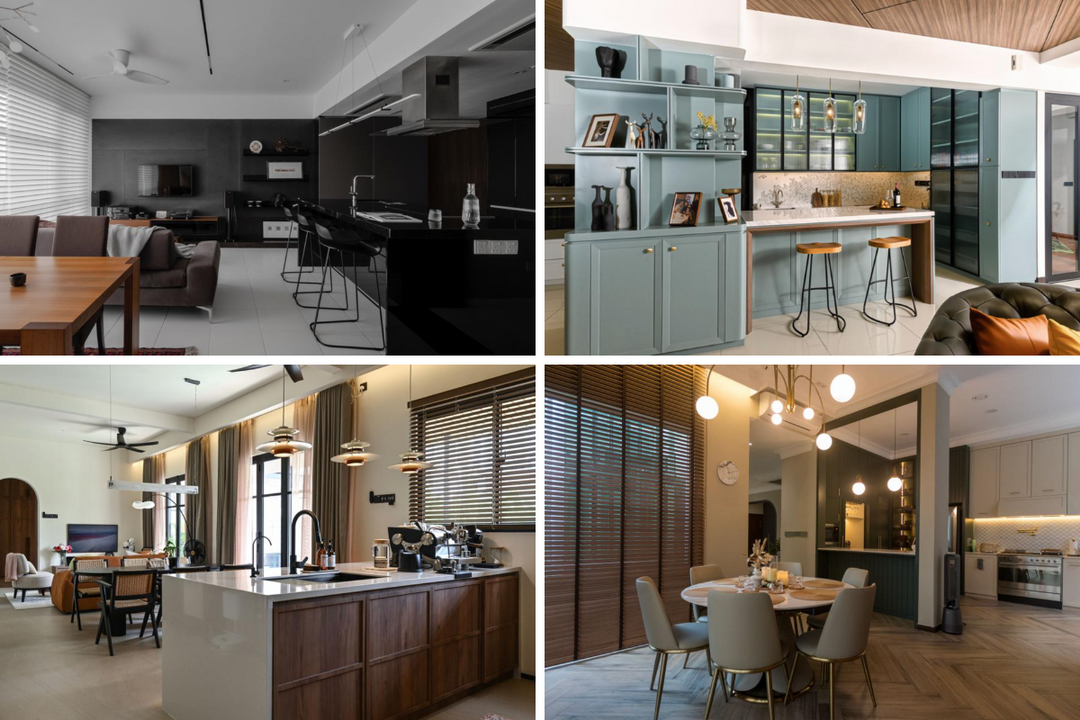
Understanding IP Ratings for Kitchen Lighting in Malaysia
IP rating is a two-digit code that defines a light fitting's resistance to solid particles and moisture. In kitchen lighting, the second digit is most important — it indicates water resistance. IP20 = no moisture protection (suitable for dry kitchens only). IP44 = protected against water splashes from any direction (minimum for wet kitchens). IP65 = fully dust-tight and protected against water jets (recommended for outdoor kitchens or above the hob in wet kitchens).
| IP Rating | Protection Level | Recommended For |
|---|---|---|
| IP20 | No moisture protection | Dry kitchens, living areas, standard indoor use |
| IP44 | Splash-proof from all directions | Wet kitchens — minimum standard for steam and splash zones |
| IP54 | Dust-protected + splash-proof | Above-hob task lighting, heavy cooking wet kitchens |
| IP65 | Dust-tight + water jet resistant | Outdoor kitchens, balcony kitchen areas |
Under-Cabinet Lighting in Malaysia: What You Need to Know
Under-cabinet lighting is the most impactful single lighting improvement available in any Malaysian kitchen. It is also the most frequently skipped — and the most commonly regretted. The reason homeowners skip it is almost always the same: they did not plan the wiring point before cabinet installation, making it difficult or expensive to add later.
Types of Under-Cabinet Lighting
| Type | Best For | Installation Note | Typical Cost (Malaysia) |
|---|---|---|---|
| LED Strip Lights | Most kitchens — flexible, dimmable, even coverage | Requires wiring channel in cabinet base — plan before installation | RM80–RM250 per run |
| LED Puck Lights | Targeted spots — specific prep zones or display areas | Can sometimes be added later with surface wiring | RM50–RM150 per light |
| Integrated LED Bar | Modern kitchens with precise linear light distribution | Must be planned into cabinet base design — flush mount | RM150–RM400 per bar |
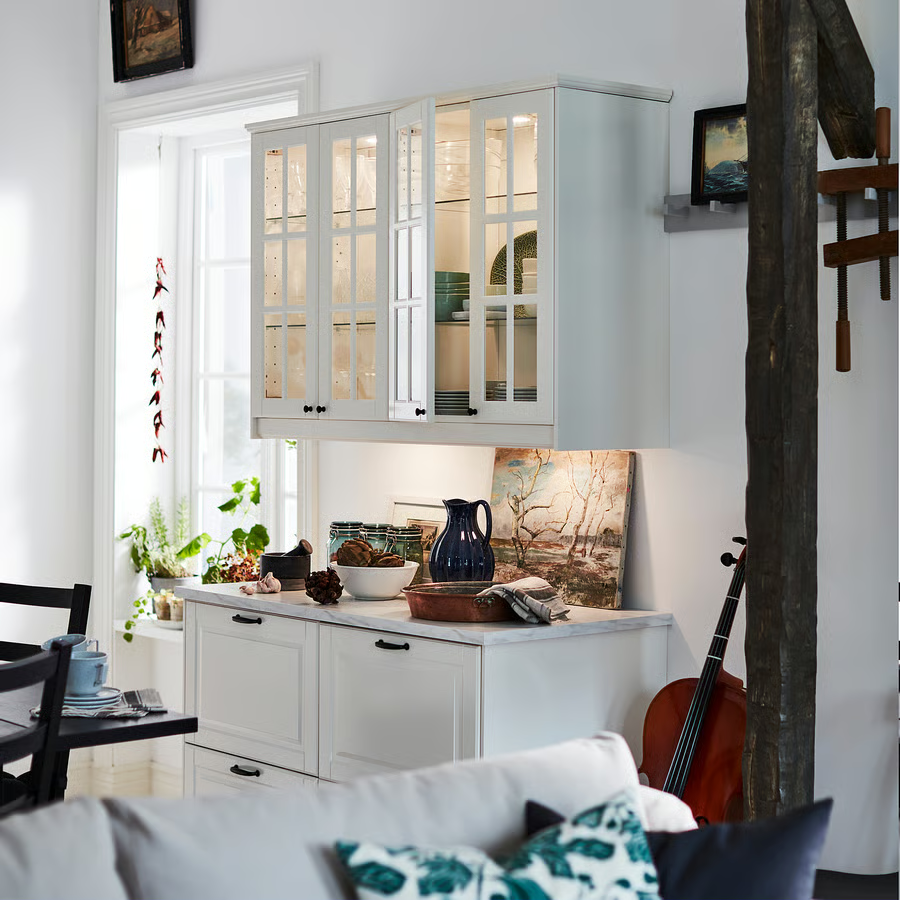
How Much Light Does Each Area of a Malaysian Kitchen Need?
Lux is the unit used to measure illuminance — the amount of light falling on a surface. Different kitchen zones need different lux levels depending on the task being performed. The table below provides practical benchmarks for Malaysian kitchen lighting planning.
| Kitchen Zone | Recommended Lux | Light Type | Notes |
|---|---|---|---|
| General circulation | 150–300 lux | Ambient — ceiling downlights | Base level for moving around the kitchen comfortably |
| Food preparation countertop | 500–800 lux | Task — under-cabinet LED | Adequate for chopping, measuring, and prep work |
| Hob / cooking zone | 500–600 lux | Task — overhead downlight or cooker hood light | Clarity for monitoring cooking and reading labels |
| Sink zone | 400–600 lux | Task — under-cabinet or ceiling downlight above sink | Hygiene and food washing require good visibility |
| Island dining surface | 200–350 lux | Accent — pendant lights | Lower lux suitable for dining; raise if island is used for prep |
| Pantry / storage | 200–400 lux | Interior cabinet LED or ceiling light inside pantry | Adequate to identify stored items clearly |
Common Kitchen Lighting Mistakes Malaysian Homeowners Make
-
Relying on a single ceiling light for the whole kitchen
One central ceiling lamp creates uneven illumination — bright in the centre, dark in corners, and shadowed at the countertop when you stand in front of it. Replace with multiple evenly-spaced downlights for ambient coverage, then add task lighting separately.
-
Not planning under-cabinet wiring before cabinet installation
The most common and most regretted lighting mistake in Malaysian kitchen renovations. Wiring channels must be planned into the upper cabinet base before installation. Retrofitting after the fact requires expensive rework or unsightly exposed conduit.
-
Using non-IP-rated fittings in the wet kitchen
Standard IP20 ceiling lights are not designed for steam and moisture exposure. In a Malaysian wet kitchen where daily wok cooking, boiling, and steaming are the norm, non-rated fittings will fail prematurely and create safety risks. Always specify IP44 minimum for wet kitchen environments.
-
Using fluorescent tubes instead of LED
Fluorescent lighting produces a flickering, harsh, and uneven light that degrades over time. In Malaysia's heat, fluorescent tubes have a significantly shorter lifespan than LED. LED lighting uses 50–75% less energy, lasts 15,000–50,000 hours, handles heat better, and produces more consistent colour output. There is no practical reason to use fluorescent in a new kitchen renovation.
-
Choosing pendant lights above the wet kitchen hob
Pendant lights over the hob in a wet kitchen accumulate cooking oil and grease on the shade, cord, and fitting. They become a maintenance problem within months of daily Malaysian cooking. Over the wet kitchen hob, use recessed or surface-mounted IP-rated fittings instead. Save pendants for the island in the dry kitchen where cooking oil is not a factor.
-
Forgetting a light switch near the kitchen entrance
Kitchen lighting should be controllable from the kitchen entrance — so you can switch on task lighting before entering a dark space carrying items. A multi-way switch setup that controls kitchen lighting from both the entrance and a cooking position is a basic comfort feature many homeowners forget to specify.
Choosing the Right LED Lights for Malaysian Kitchens
LED is the correct technology for all kitchen lighting in Malaysia. The question is not whether to use LED — it is which LED specification to use for each zone. Here is what to look for when selecting LED lights for your kitchen:
| Specification | What to Look For | Why It Matters |
|---|---|---|
| Colour Rendering Index (CRI) | CRI 80 minimum; CRI 90+ preferred for food prep | Higher CRI means food colours look accurate and natural — important for kitchen use |
| Colour Temperature (K) | 2700–3000K (warm dry kitchen); 4000K (neutral wet kitchen) | Directly affects atmosphere and visual clarity of the cooking environment |
| IP Rating | IP20 (dry kitchen); IP44 minimum (wet kitchen) | Moisture resistance essential for wet kitchen safety and longevity |
| Wattage / Lumen Output | Match to lux requirements by zone (see guide above) | Under-specified lighting leaves work zones too dim; over-specified wastes energy |
| Dimmability | Dimmable LED recommended for dry kitchen and accent zones | Allows adjustment between task mode (bright) and ambience mode (dim) |
| Brand reliability | Established brands: Philips, Osram, Panasonic, Havells | Cheap no-brand LEDs often have inconsistent colour output and fail earlier in heat |
Note: EverKitchen does not sell lighting products directly. The brand recommendations above are general guidance based on market reliability. Verify current product availability with your electrical supplier.
Kitchen Lighting Planning Checklist — Before Renovation Begins
Use this checklist when discussing your kitchen lighting plan with your contractor and electrician. Every point should be confirmed before any cabinet work begins.
- Confirm ceiling downlight positions — spaced evenly across the kitchen ceiling, not just in the centre. Mark positions on site before electrical work begins.
- Confirm under-cabinet wiring positions — one wiring point per run of upper cabinets. Tell your electrician exactly where the upper cabinets will be positioned so the wiring channel is in the right location.
- Specify IP rating for wet kitchen fittings — minimum IP44 for all wet kitchen ceiling lights. Confirm with your electrician before purchasing fittings.
- Plan pendant light positions for island or dining zone — pendant wiring must come through the ceiling at the exact position of the pendant. Confirm island dimensions before marking wiring positions.
- Add a dimmer switch for dry kitchen ambient and accent zones — confirm compatibility with chosen LED fittings before purchase (not all LEDs are dimmable).
- Plan cooker hood lighting — most cooker hoods include a built-in light. Confirm the hood model and its integrated lighting specification before the hob zone ceiling lighting is planned.
- Confirm switch positions — kitchen entrance and hob-adjacent switch positions for convenience. Consider multi-way switching for larger kitchens.
Planning Your Kitchen Renovation?
Our team helps Malaysian homeowners plan kitchen lighting as part of the full renovation scope — so nothing gets missed before cabinet installation begins. Visit our showrooms in PJ, Subang Jaya, or Kajang.
Chat With Our Kitchen Design ExpertsFrequently Asked Questions
What is the best kitchen lighting for Malaysian homes?
The best kitchen lighting in Malaysia uses three layers: ambient ceiling downlights (LED, 4000K neutral white, evenly spaced) for general illumination; under-cabinet LED strips (4000K) for shadow-free task lighting on the countertop; and accent lighting such as pendants or strip lights for the dry kitchen's visual appeal. Wet kitchens need IP44-rated fittings minimum, while dry kitchens benefit from dimmable warm white options for atmosphere.
Should I use warm white or cool white lighting in my kitchen?
Use warm white (2700K–3000K) in dry kitchens and dining areas for a comfortable, inviting atmosphere. Use neutral to cool white (4000K–5000K) in wet kitchens and for under-cabinet task lighting where visual clarity, food inspection, and hygiene visibility are priorities. You can mix both — warm for accent and pendants in the dry kitchen, cool for task lighting throughout — to balance atmosphere and practicality.
Do I need special lighting for a wet kitchen in Malaysia?
Yes. Wet kitchens produce significant steam and moisture from daily Malaysian cooking — boiling, steaming, and wok frying. Standard IP20 ceiling lights are not moisture-resistant and will fail over time in these conditions. All wet kitchen ceiling and task lighting should be a minimum IP44 rated, which means they are protected against water splashes from any direction. For above-hob positions, IP54 or IP65 is preferable.
Can I add under-cabinet lighting after my kitchen is already installed?
It is possible but difficult and expensive. If the wiring channel was not planned into the upper cabinet base before installation, adding wiring requires either opening the cabinet base (which may damage the cabinet), running exposed surface conduit (which looks unsightly), or using battery-operated strip lights (which are less powerful and need regular charging). The strong recommendation is to plan and wire under-cabinet lighting positions before any cabinet work begins.
How many downlights do I need for my kitchen?
A general rule for Malaysian kitchens: one 7–10W LED downlight per 1 to 1.5 square metres of ceiling area, spaced evenly for consistent coverage. For a 10 sq ft kitchen, 6 to 8 downlights positioned in a grid pattern will give even ambient coverage without dark zones. Supplement with under-cabinet task lighting for the countertop zones — downlights alone cannot adequately illuminate the working surface when your body blocks the ceiling light.
What is the difference between task lighting and ambient lighting in a kitchen?
Ambient lighting illuminates the whole room at a general level — it allows you to move around and see the overall space. Task lighting provides focused, high-lux illumination on specific working surfaces — the countertop, hob, and sink — where precise visual clarity is needed for food preparation and cooking. Most Malaysian kitchens only have ambient lighting. Adding task lighting (typically under-cabinet LED strips) is the single most impactful lighting improvement available to any kitchen that lacks it.