Choosing a kitchen cabinet maker in Malaysia is a high-stakes decision. Unlike buying a sofa or a dining table, a kitchen is a permanent fixture. If you get it wrong, you are stuck with sagging doors, mouldy carcasses, and renovator's remorse for the next ten years.
In the Malaysian market, we are spoiled for choice — but that is also the problem. From independent carpenters to high-end modular brands, the price gap can be massive and the technical jargon can make your head spin. This guide is not about finding the cheapest option. It is about finding the right partner so you do not end up as another renovation horror story on a Facebook community group.
- Malaysia's humidity and heavy cooking culture make material selection far more critical here than in most other countries — not all materials survive the conditions.
- The material inside the cabinet (carcass) determines longevity more than the door colour or finish you see on the outside.
- Anyone with a truck and a saw can call themselves a kitchen contractor — learn how to vet the real ones from the unreliable ones.
- Hardware quality (hinges, drawer runners) is the most overlooked decision in kitchen renovation — and one of the most impactful on daily usability.
- Hidden costs are common in renovation quotes — always verify what is and is not included before signing anything.
- A written warranty is non-negotiable. Verbal promises from contractors mean nothing once the job is done.
The Malaysian Kitchen Reality Check
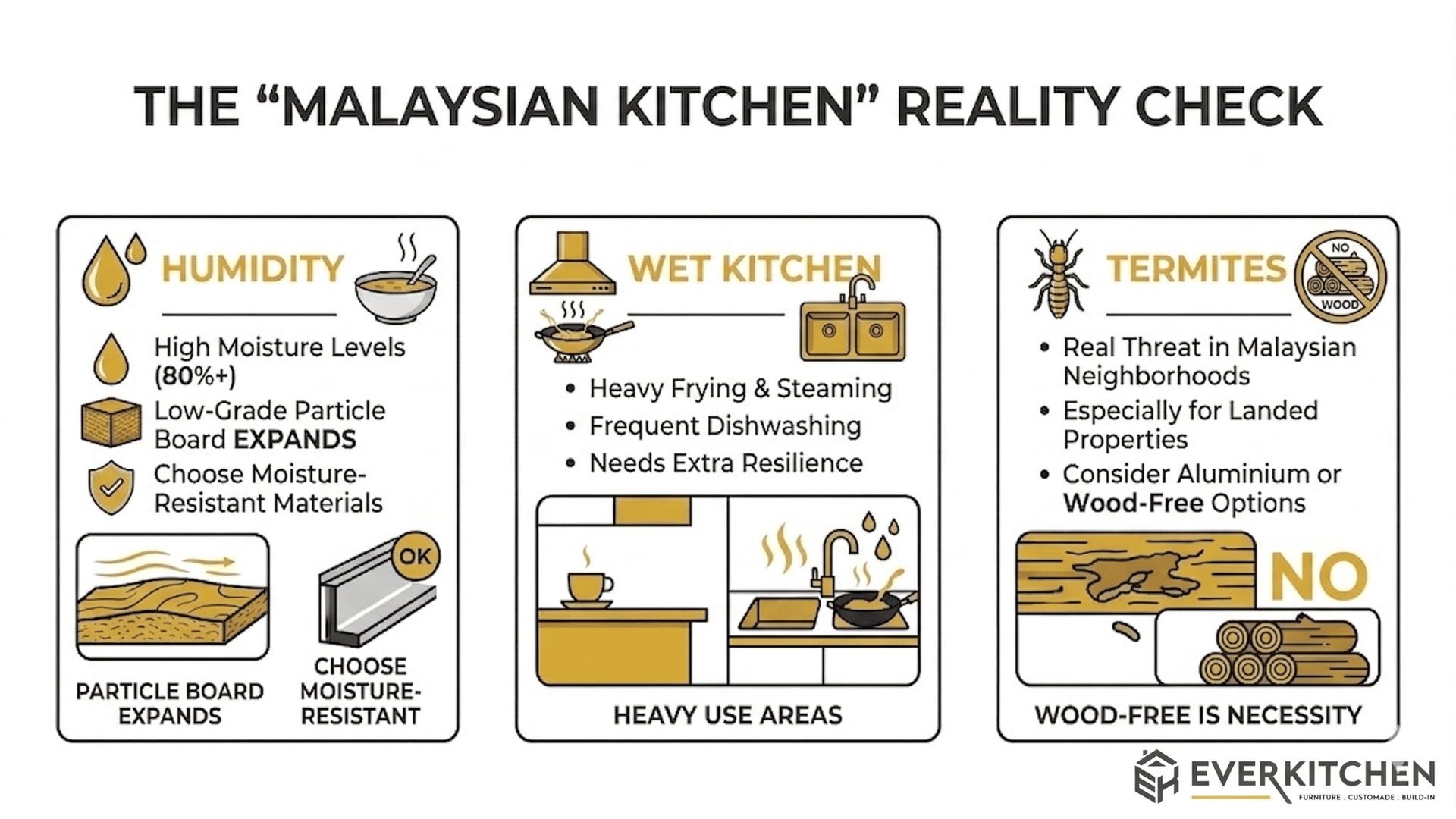
Before you look at a single catalogue, we need to talk about why kitchens in Malaysia are different from those in Europe or the US. Our environment is uniquely aggressive toward furniture and cabinetry — and most imported design advice does not account for this.
Moisture is the number one killer of kitchen cabinets in Malaysia. Low-grade particle board will expand over time just from ambient air humidity — without any direct water contact.
Most Malaysian homes separate dry and wet kitchens. If your contractor suggests the same materials for both, be careful — the wet kitchen requires a significantly higher level of material resilience.
Especially near greenery. Wood-free options like aluminium are no longer just a trend for landed property owners — they are increasingly a practical necessity.
Decoding the Materials — What Is Actually Inside the Box?
When you get a quote for a kitchen renovation in Malaysia, the price is largely determined by what is inside the cabinet — not the colour or finish you see on the outside. Most homeowners spend time choosing door colours and zero time understanding what the carcass is made of. This is where regrets begin.
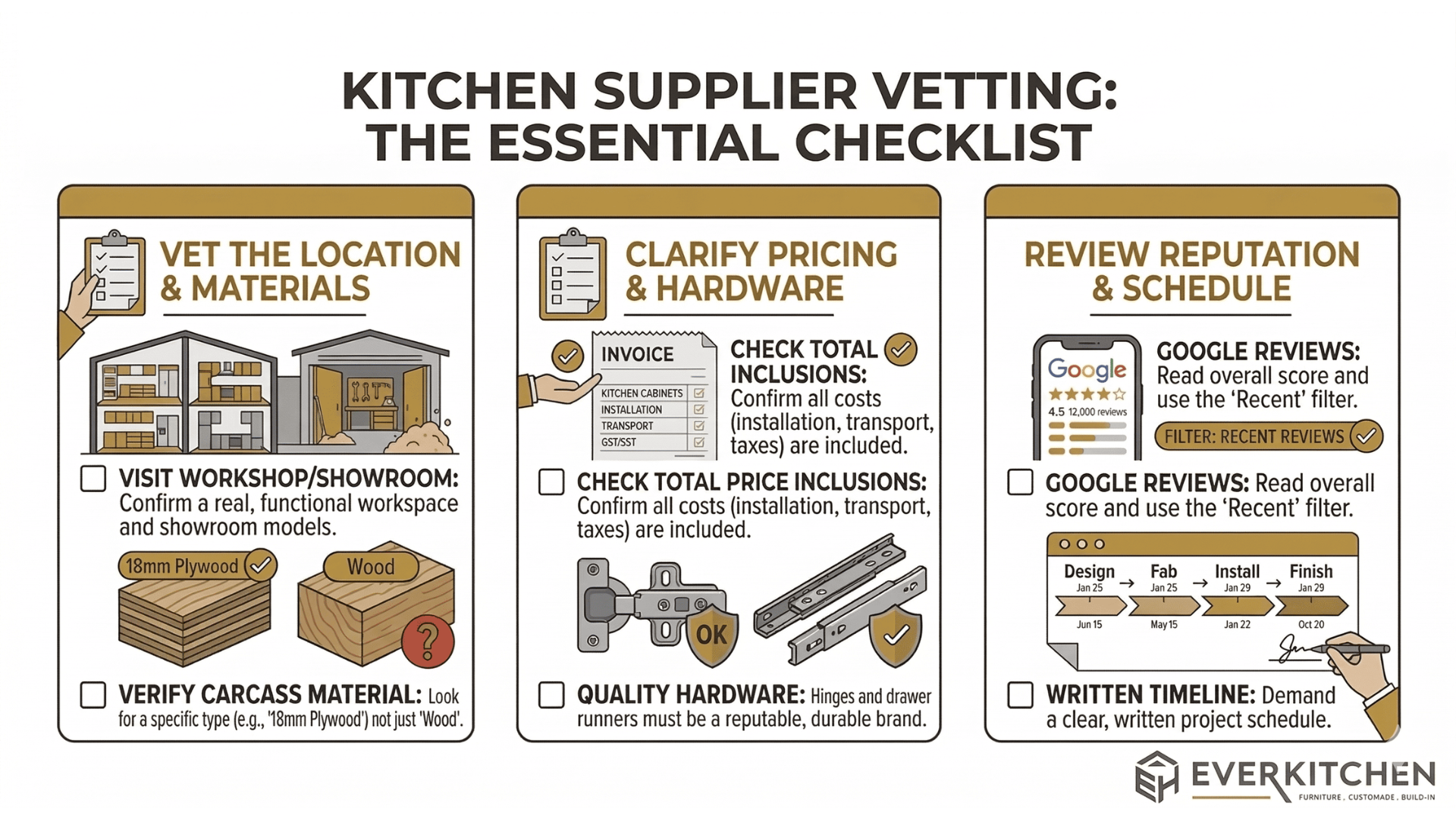
Entry Level: Melamine / Chipboard
The most common material because it is budget-friendly — essentially compressed wood shavings bonded with resin. It is great for dry kitchens or rental properties. However, if water gets into the core through a poorly sealed edge, it will swell like a sponge. Once it swells, there is no fixing it — the whole unit needs to be replaced.
The All-Rounder: Plywood (Blockboard)
Most experienced kitchen contractors in Malaysia will recommend plywood. It consists of thin layers of wood glued together in alternating grains, making it significantly more water-resistant than melamine. It holds screws better, meaning hinges will not start sagging after two years of use. If you are building a home to live in for the long term, this is usually the smartest value-for-money pick.
The Heavy-Duty Choice: Aluminium
Ten years ago, aluminium kitchens looked like something out of a hospital. Today, they can be finished to look exactly like wood or stone. It is 100% waterproof and 100% termite-proof — the ultimate choice for a Malaysian wet kitchen. Modern aluminium cabinets use dampening technology that makes them feel as solid as wood.
| If Your Priority Is... | Go For... | Why |
|---|---|---|
| Budget-friendly or dry kitchens | Melamine | Economical, plenty of colours, acceptable for light use |
| Durability and value (landed homes) | Plywood | Stronger, more water-resistant, holds screws better long-term |
| Heavy Asian-style cooking | Aluminium | Zero rot, zero termites, 100% waterproof — built for wet kitchens |
| Tight condo, maximise light | Full-height cabinets + High Gloss panels | Bounces light, creates a seamless, airy feel in small spaces |
| Clean, minimal aesthetic | Matte finish flat panel doors | Timeless, easy to wipe, suits both modern and transitional kitchens |
For a detailed breakdown of all 9 cabinet materials used in Malaysia, read our full kitchen cabinet materials guide.
How to Spot a Reliable Contractor vs. a Problem One
In Malaysia, anyone with a truck and a circular saw can call themselves a kitchen contractor. To protect your deposit and your renovation, you need to vet them properly before signing anything.
What to Look For
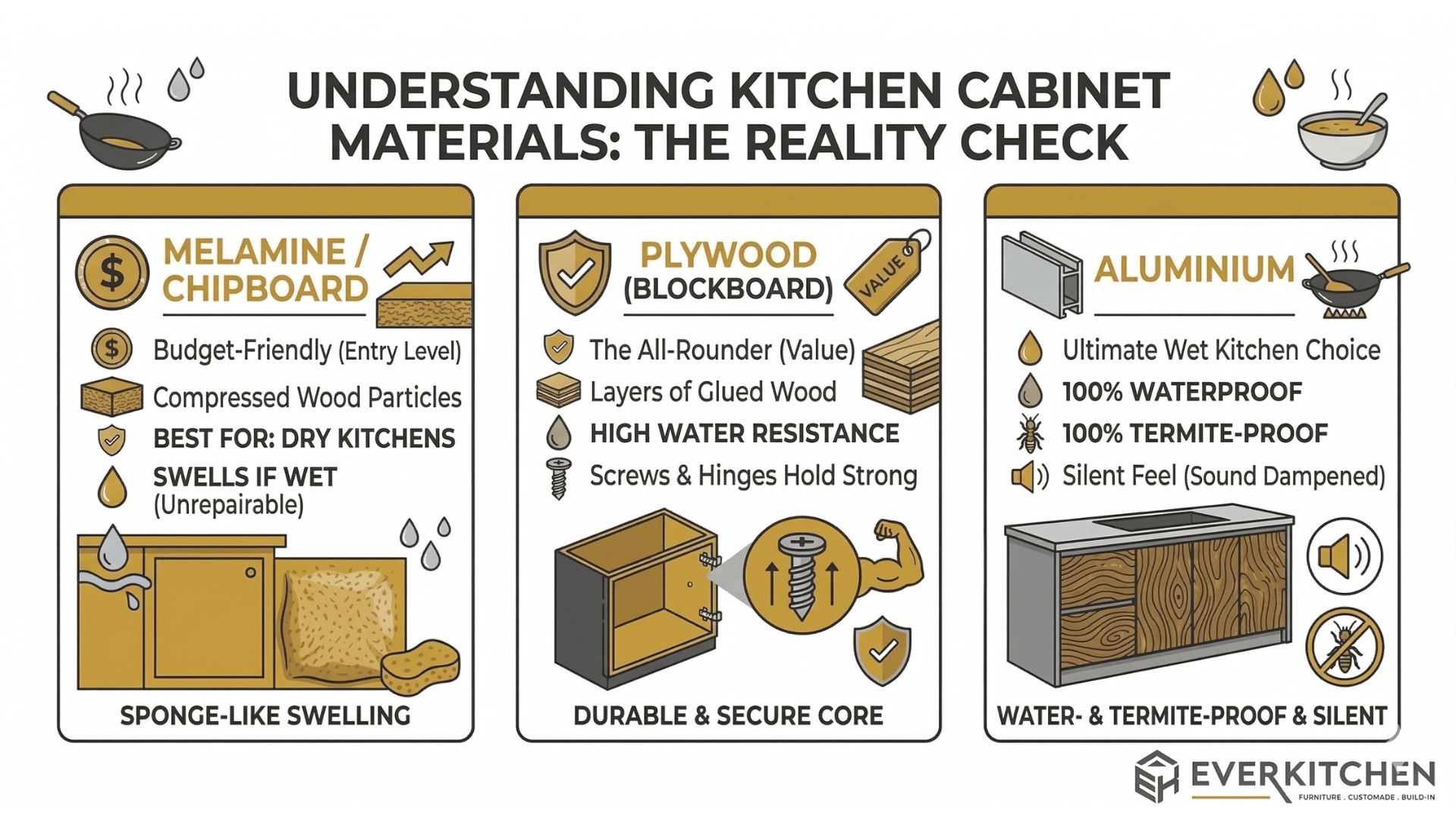
- Ask to see a live project in progress — do not rely on Facebook photos, which could be sourced from anywhere. A confident maker will let you visit an active installation. Look at how they handle piping, how they level cabinets on an uneven floor, and how clean their workspace is.
- Test their communication speed — if a contractor takes three days to reply to a simple question about a quote, imagine how hard they will be to reach when your kitchen is half-finished and the sink is leaking. Responsiveness before the job predicts reliability during it.
- Look for specific material specifications in the quote — "18mm moisture-resistant plywood carcass" is a real spec. "Wood cabinet" is not. A professional contractor should be able to state exactly what they are using.
- Check Google Reviews, specifically the recent ones — older reviews may not reflect current workmanship or service quality. Sort by most recent and look for consistent patterns, not isolated complaints.
- Verify they have a physical showroom or workshop — a showroom gives you somewhere to go if issues arise after installation. It also indicates a level of business stability that reduces risk.
Red Flags to Walk Away From
- The "Yes-Man" contractor — if you ask for a 4-foot cantilevered island with no support and they say "No problem, boss!" without raising any structural concerns, that is a warning sign. A competent contractor pushes back on impractical requests.
- Vague quotes without line items — "Kitchen cabinet — RM18,000" with no breakdown of materials, brand of hardware, or scope of installation is not a professional quote.
- No written contract or warranty — "Don't worry, boss, just call me if anything happens" is worth nothing once the job is done. Any reputable contractor provides a signed agreement.
- Unusually low quotes without explanation — significantly cheaper than the market rate usually means cheaper materials, lower-grade hardware, or corners being cut somewhere in the process.
The Countertop — Where the Real Work Happens
Your cabinets are the bones, but the countertop is the surface you will be scrubbing, chopping, and spilling soy sauce on every day. It needs to handle both Malaysian cooking intensities and daily cleaning without deteriorating.
| Countertop | Best For | Watch Out For |
|---|---|---|
| Quartz | Most Malaysian kitchens — non-porous, stain resistant | Cheap quartz has high resin content and can scorch under hot pots |
| Granite | High durability, unique natural appearance | Porous — needs sealing every 1–2 years to prevent stain absorption |
| Sintered Stone | Premium dry kitchens — extremely heat and scratch resistant | Higher price point; needs professional installation to avoid cracking |
| Solid Surface | Seamless joins, great for integrated sinks | Scratches easily, does not handle high heat well |
Hardware — The Most Overlooked Decision
Most homeowners spend 90% of their time choosing the door colour and 0% choosing the hinges. This is a significant mistake. The hinges and drawer runners are the only moving parts in your kitchen — they are used dozens of times every day for the next 10 to 15 years.
If your contractor says they use "local brand" hardware to save costs, insist on an upgrade. Brands like Blum, Häfele, or Hettich are the gold standard in Malaysia. They offer soft-close mechanisms that prevent doors from slamming and are tested to 100,000+ open-close cycles. In Malaysia's humid conditions, cheap hinges rust and snap within a few years — the replacement cost and inconvenience far exceeds what you would have saved upfront.
Understanding the Hidden Costs
You receive a quote for RM15,000 and think it fits your budget. But does that quote actually include everything? In Malaysia, renovation quotes can vary significantly in scope — always verify what is included before signing.
Disconnecting the old sink and connecting the new one. Often quoted separately, especially if water points need to be relocated.
Wiring the hob, hood, and oven. New power points or relocated sockets add to the total — especially for induction hobs which need dedicated circuits.
Tiling the wall behind the stove and sink is commonly excluded from basic cabinet quotes. Clarify upfront whether tiling is included or billed separately.
In Malaysia, cabinets typically sit on a concrete plinth to prevent water damage during floor mopping. Check whether this base work is included or extra.
Design — Function Always Before Fashion
A beautiful kitchen is a daily frustration if you cannot open the fridge while someone stands at the sink. Before Pinterest aesthetics, make sure your design works spatially. The most common design flaws we see in Malaysian kitchens:
- Single ceiling light only — without under-cabinet LED task lighting, you chop vegetables in your own shadow. Task lighting is essential, not decorative.
- The dead corner — L-shaped kitchens almost always have a deep corner where things disappear. A LeMans tray or Magic Corner pull-out unit solves this completely and should be specified at design stage, not added later.
- Fridge placed next to the stove — the heat from the stove forces the fridge to work harder, increasing your electricity bill and shortening the fridge's lifespan. Always keep them separated.
- Not enough counter space — especially in smaller kitchens, the instinct is to add more cabinets. Often what you actually need is more continuous countertop run for prep work.
What to Expect — A Realistic Timeline
A professional cabinet maker in Malaysia typically follows this process. If a contractor promises a full custom kitchen from scratch in 7 days, they are either using pre-made cookie-cutter sizes that will not fit your walls, or cutting corners somewhere in the process.
-
1Site Measurement and Design — 1 week On-site measurement, 3D design preview, material confirmation, and finalising the quotation before any fabrication begins.
-
2Fabrication (Off-site) — 3 to 5 weeks Cabinet boxes are built in the workshop or factory. This is where material and workmanship quality is determined — not on-site.
-
3On-Site Installation — 3 to 5 days Cabinets are delivered and installed. Electrical and plumbing integration happens in this phase.
-
4Countertop Installation — 1 additional week Countertops are templated and cut after base cabinets are installed to ensure a perfect fit. Cannot be done in advance.
Warranty — Get It in Writing
"Don't worry, boss, if anything happens just call me." In the renovation world, those words are worth nothing. You need a written warranty. A reputable kitchen contractor should provide:
- Workmanship warranty — 1 to 2 years — covers misaligned doors, peeling panels, and installation-related issues that appear after move-in
- Material warranty — 5 to 10 years — often provided by the manufacturer of the countertop brand or the hardware brand (e.g. Blum's lifetime warranty on their soft-close systems)
- A signed contract with clear scope — material specifications, timeline, payment terms, and warranty terms all in writing before work begins
Final Checklist — Before You Pay the Deposit
Use this as your final sanity check before committing to any kitchen cabinet maker in Malaysia:
- Have I visited their physical showroom or seen an active installation in progress?
- Is the carcass material specifically listed — e.g. "18mm moisture-resistant plywood", not just "wood cabinet"?
- Does the quote include installation, transport, and all applicable taxes?
- Are the hinges and drawer runners a named brand — Blum, Häfele, or Hettich?
- Have I checked their Google Reviews, filtered to most recent?
- Is there a clear written timeline with a confirmed completion date?
- Does the quote include plumbing, electrical, backsplash tiling, and the cabinet base — or are those extra?
- Is there a written workmanship warranty for at least 1 year?
- Have I been provided a signed contract before paying the deposit?
Ready to Build Your Kitchen the Right Way?
Whether you are in a high-rise in KL or a terrace in Selangor, the EverKitchen team is ready to help you design a kitchen that is as practical as it is beautiful — with full transparency on materials, scope, and cost before anything is signed. Visit our showrooms in PJ, Subang Jaya, or Kajang.
Get a Free Consultation on WhatsAppFrequently Asked Questions
How do I choose a reliable kitchen cabinet maker in Malaysia?
Look for a cabinet maker with provable project experience, transparent and itemised pricing, and clear material specifications — specifically the board type, edging, and hardware brand. Always verify with real project photos or a live site visit, check recent Google Reviews, and confirm they provide on-site measurement and a 3D design preview before you commit. A reputable maker will also provide a written contract and warranty before any work begins.
What should I check before hiring a kitchen cabinet contractor?
Key things to verify before paying a deposit: the carcass material specified (e.g. "18mm moisture-resistant plywood", not just "wood"), the hardware brand (insist on Blum, Häfele, or Hettich), what is and is not included in the quote (plumbing, electrical, tiling, base work), the warranty terms in writing, and whether there is a clear timeline with a completion date. Also confirm the contractor has a physical showroom or workshop you can visit if issues arise post-installation.
How long does it take to install kitchen cabinets in Malaysia?
A typical full kitchen renovation in Malaysia takes 5 to 7 weeks from design confirmation to final completion. This breaks down into roughly 1 week for measurement and design, 3 to 5 weeks for off-site fabrication, 3 to 5 days for on-site installation, and an additional week for countertop templating and fitting. If a contractor promises a fully custom kitchen from scratch in under 2 weeks, that is a red flag — they are either using non-custom sizing or cutting corners in fabrication.
What are the most common mistakes when choosing a kitchen cabinet maker?
The most costly mistakes are: choosing based on price alone without checking material specs, accepting a vague quote without itemised breakdowns, skipping site measurement (which always leads to poor fit), not getting a written contract or warranty, and not verifying hardware brand quality. Another common one is not asking what the hidden costs are — plumbing, electrical work, tiling, and the cabinet base plinth are often excluded from initial quotes.
What is the best cabinet material for Malaysian kitchens?
For wet kitchens where heavy cooking, steam, and water are constant — aluminium is the most reliable long-term choice. It is 100% waterproof and termite-proof. For dry kitchens, moisture-resistant plywood carcasses with laminate or acrylic door finishes deliver the best combination of durability and aesthetics for most Malaysian homeowners. Standard melamine on particle board works for rentals or light-use spaces, but it is not recommended for kitchens that see regular Malaysian cooking. Read our full breakdown at Top 9 Kitchen Cabinet Materials in Malaysia.
Is a written warranty important when renovating a kitchen in Malaysia?
Yes — it is non-negotiable. A verbal "don't worry, just call me" from a contractor carries no legal weight. A reputable kitchen maker should provide a workmanship warranty of at least 1 to 2 years covering issues like misaligned doors or peeling panels, and material warranties from the countertop or hardware manufacturer of 5 to 10 years. Keep your signed contract, warranty document, and all payment receipts. If a contractor refuses to provide written documentation, do not pay the deposit.