The open kitchen looks good in every photo. Clean counters, natural light, a seamless flow from cooking to living. In developer showrooms it is always the right answer.
Then you move in. You fry sambal on a Tuesday night and the smell settles into the sofa. You cook rendang on Sunday and the living room curtains absorb it. The cooker hood you chose because it looked sleek turns out to be barely adequate for the wok heat your family generates.
The open vs closed kitchen debate in Malaysia has a local dimension most international design content ignores entirely. Malaysian cooking is not a light affair — it involves high heat, extended frying, heavy spices, and wok cooking that produces oil vapour no standard hood was designed to handle. The right layout depends on how your family actually cooks, not on how the kitchen will photograph.
This guide covers both layouts honestly, explains where each works and where it does not, and walks through the semi-open hybrid that a growing number of Malaysian homeowners are choosing because it resolves the central tension without forcing a compromise.
- Open kitchens work well in condos and for light-cooking households — they make small spaces feel larger and suit social lifestyles
- Closed kitchens are more practical for daily Malaysian cooking involving wok frying, curry, and sambal — oil, heat, and smell stay contained
- The semi-open kitchen with a glass partition is the most popular solution in Malaysian landed homes — cooking containment without feeling enclosed
- Property type matters: condos suit open layouts, landed homes suit wet and dry kitchen separation
- Ventilation quality determines whether any open kitchen actually works — the hood is not optional, it is the entire system
The Real Question Is Not Open or Closed — It Is How You Cook
Before looking at layouts, answer five questions about your household.
| Question | Open Kitchen Fits | Closed Kitchen Fits |
|---|---|---|
| How often do you cook heavy Malaysian food? | Rarely or occasionally | Daily or most days |
| What type of cooking? | Light prep, reheating, baking | Wok frying, curry, sambal, rendang |
| Who is in the kitchen? | One person, minimal mess | Multiple family members, heavy use |
| Property type? | Condo or compact apartment | Landed home with space for two kitchens |
| Priority? | Space, light, social feel | Containment, storage, practicality |
Open Kitchen: What It Gets Right and Where It Falls Short

Source: madeincookware.com
- Makes small condos feel significantly larger — no walls breaking up the floor plate
- Natural light travels further into the home
- Social cooking — you stay connected to family and guests while cooking
- Photographs well, broad appeal in the condo resale market
- Easier supervision of young children in the adjacent space
- Standard hoods cannot handle daily wok cooking in an open layout
- Oil vapour settles on furniture, curtains, and soft furnishings
- Strong cooking smells spread through connected spaces and linger
- Kitchen noise (blenders, hood, pressure cooker) travels to living area
- Maintenance scope is wider — grease reaches beyond the kitchen
- Any mess or mid-cook disorder is visible from the living area
Closed Kitchen: What It Gets Right and Where It Falls Short
- Smell, heat, and mess stay contained — living area remains separate
- More storage — upper cabinets can run wall to wall
- Easier to keep the rest of the home presentable when mid-cook
- Noise does not carry to living and dining areas
- Lower cleaning scope — grease is contained to one zone
- Ideal for festive cooking when the kitchen is in heavy use and the house has visitors
- Feels enclosed in small spaces without adequate ventilation
- No visual connection to the rest of the home while cooking
- Heat and humidity build up faster in a compact enclosed space
- Requires a door, which creates traffic flow considerations
The Semi-Open Kitchen: Why This Is the Most Popular Choice in Malaysian Landed Homes
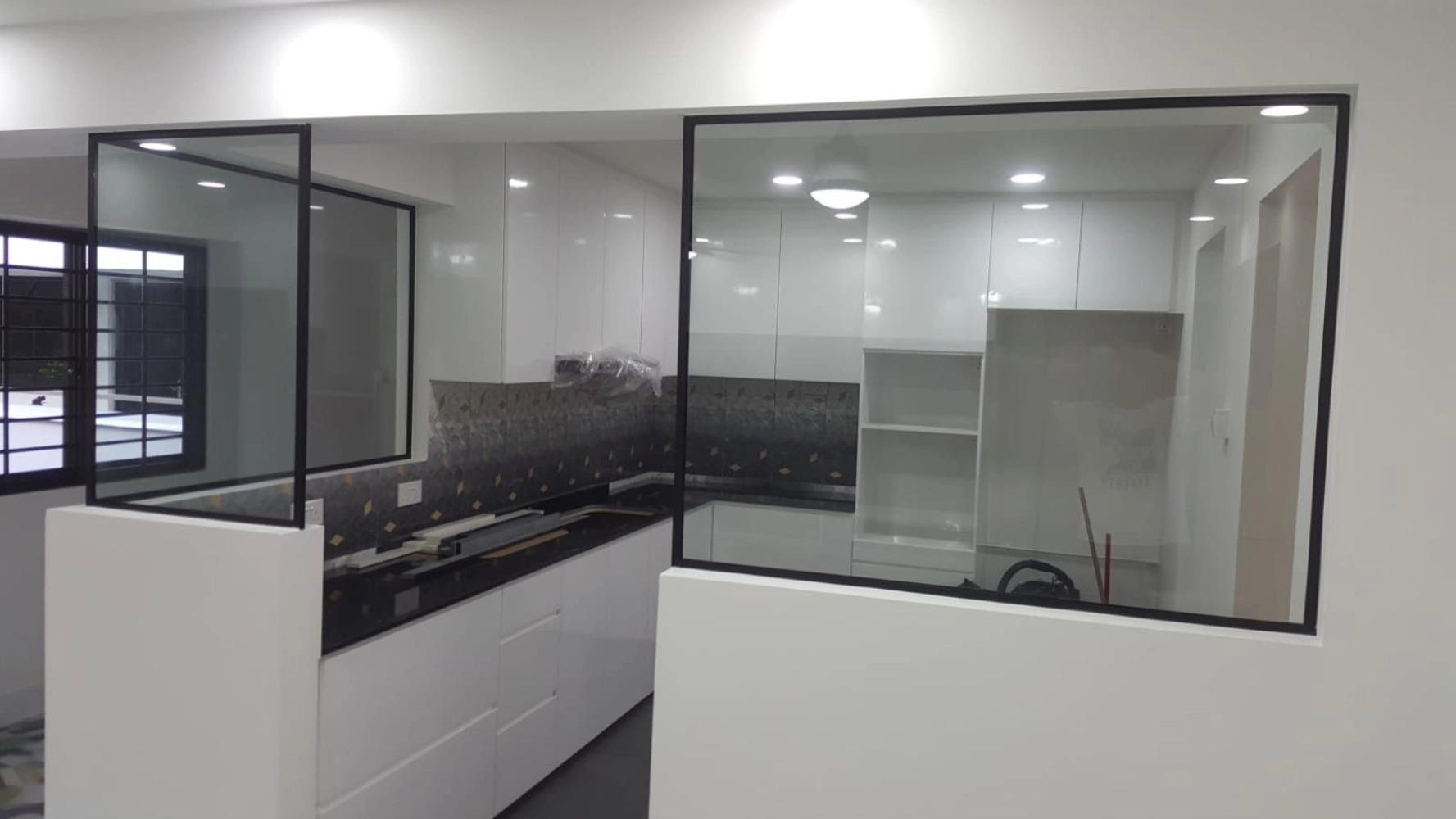
Source: BM Glass
The semi-open kitchen with a glass partition between wet and dry zones resolves the central tension that neither a fully open nor a fully closed kitchen can solve cleanly for Malaysian households.
The wet kitchen is fully enclosed: four walls, full wall tiling, aluminium cabinets designed for humidity and heat, and a high-capacity extraction hood. This is where serious cooking happens. Oil, smoke, and smell stay here.
The dry kitchen is open to the living or dining area: lighter cabinet finishes, an island or peninsula counter, natural light, and visual connection to the rest of the home. Light food prep, serving, and social interaction happen here.
A tempered glass partition or sliding glass door connects the two zones. Closed during heavy cooking, it contains everything from the wet kitchen. Opened when cooking is done, the two spaces become one. It is a genuinely Malaysian design innovation — the concept of separating wet and dry kitchen areas actually originated in Malaysia before being adopted across Singapore and internationally.
| Feature | Open Kitchen | Closed Kitchen | Semi-Open |
|---|---|---|---|
| Smell containment | Poor | Excellent | Good when closed |
| Space feel | Spacious | Enclosed | Spacious (dry zone) |
| Storage capacity | Moderate | High | High (wet) + moderate (dry) |
| Suited for heavy cooking | No | Yes | Yes |
| Social cooking feel | Excellent | Poor | Good (dry kitchen open) |
| Maintenance effort | High | Low | Low (wet contained) |
| Best property type | Condo | Landed/older homes | Landed homes |
| Renovation cost | Standard | Standard | Higher (two zones) |
Which Layout Suits Your Property Type
Open kitchens are most practical in condos where the overall floor plate is limited and every square metre needs to work harder. The connected space feels larger and brighter without a dividing wall. If you cook lightly or rely on delivery most days, an open kitchen is a reasonable match. For daily Malaysian cooking in a condo, a sliding glass partition provides the flexibility to contain cooking when needed without permanently enclosing the space. For condo-specific space-saving ideas, read our small kitchen design Malaysia guide.
A terrace house with a rear extension has enough depth to separate the kitchen into wet and dry zones. The rear wet kitchen handles heavy cooking; the front or extended dry kitchen serves as the functional connection to the dining area. For older terrace houses with a single linear kitchen, a glass partition mid-kitchen creates the functional separation without requiring a full structural change.
Larger floor plates make it viable to design the wet kitchen as a fully standalone space, often at the rear of the property. The dry kitchen becomes a showpiece with more budget available for premium finishes, an island counter, and integrated appliances. This is where the wet and dry kitchen concept delivers its full benefit — complete separation of function and aesthetics.
Why Your Hood Determines Whether an Open Kitchen Actually Works
Every open kitchen conversation in Malaysia eventually comes back to the hood.
A standard residential range hood, typically rated between 700 and 900 cubic metres per hour, is designed for moderate European-style cooking. Wok cooking at high heat with a 36-inch burner produces heat, oil vapour, and smoke at a rate that most standard hoods cannot capture effectively — especially in an open layout where the vapour has room to expand sideways before the hood can extract it.
For an open kitchen to work with Malaysian cooking habits, the hood specification needs to match the cooking intensity. A high-capacity island hood or ceiling-mounted extractor rated at 1,000 to 1,500 cubic metres per hour with a proper external exhaust duct is the minimum for daily wok cooking in an open setting.
Which Layout Is Right for You?
| Your Situation | Recommended Layout |
|---|---|
| Condo, light cooking, social lifestyle | Open kitchen |
| Condo, daily Malaysian cooking | Semi-open with sliding glass or roller partition |
| Terrace house, single kitchen, daily wok cooking | Closed kitchen or glass partition mid-kitchen |
| Landed home with rear extension | Wet and dry kitchen with glass partition |
| Semi-D or bungalow, budget for two full kitchens | Full wet and dry kitchen separation |
| Renovating for resale, condo market | Open kitchen (photographs well, broad buyer appeal) |

Not Sure Which Layout Works for Your Home?
EverKitchen designs kitchens across condos, terrace houses, and landed homes across the Klang Valley. A single site visit tells us more about your right layout than any guide can. Free measurement and consultation at our showrooms in PJ, Subang Jaya, and Kajang.
View Our Kitchen PackagesFrequently Asked Questions
Is an open kitchen a good idea for Malaysian homes?
It depends on your cooking habits. Open kitchens work well for households that cook lightly or infrequently, particularly in condos where space is limited. For families who cook daily Malaysian food involving wok frying, curry, or sambal, an open kitchen makes smell and oil vapour control significantly harder. The semi-open layout with a glass partition is a more practical middle ground for daily heavy cooking.
What is the difference between a wet kitchen and a dry kitchen?
The wet kitchen is where heavy cooking happens: wok frying, boiling, anything producing heat, steam, and strong smells. It is fully enclosed, tiled, and fitted with high-capacity ventilation. The dry kitchen is a lighter preparation and serving space, open or semi-open, with finishes suited to visibility and social use. The concept of separating wet and dry areas originated in Malaysia and has since spread globally.
Can I have an open kitchen if I cook Malaysian food daily?
Yes, but it requires an externally ducted hood rated at 1,000+ cubic metres per hour — not a recirculating filter hood. Without proper extraction, oil vapour and cooking smells will spread through the connected living area. A semi-open kitchen with a glass partition that closes during cooking is a more forgiving solution for daily heavy cooking without the full extraction infrastructure requirement.
How much more does a wet and dry kitchen cost compared to a single kitchen?
A wet and dry kitchen requires two separate sets of cabinets, two sets of plumbing points, separate high-capacity ventilation for the wet kitchen, and the cost of the glass partition. Budget an additional RM15,000 to RM30,000 on top of a single kitchen renovation cost, depending on the size of each zone and materials chosen.
Does an open kitchen affect property resale value in Malaysia?
In the condo market, open kitchens are generally viewed positively and photograph well for listings. In the landed home market, Malaysian buyers who cook frequently often prefer the wet and dry kitchen setup. Neither layout universally helps or hurts resale value — the condition and quality of the renovation matter more than the layout choice.
What is a semi-open kitchen?
A semi-open kitchen uses a glass partition, sliding glass door, or partial wall to separate the cooking zone from the living or dining area. In closed mode, it contains smell, heat, and mess from heavy cooking. In open mode, the two spaces flow together. It is the most popular layout choice for Malaysian landed homes where daily heavy cooking and an open-plan aesthetic are both priorities.