It is not until after the installation of the kitchen cabinets and the contractors have left the scene that most home buyers realize that there were issues with the quality. The peeling edge bands, doors that cannot shut right, drawers that shake on every tug — these problems are not just bad luck. These problems arise from using poor materials and poor detailing techniques, which might not be visible immediately, but can certainly be identified if you know where to look.
This article provides you with a handy checklist that can be used before signing the kitchen cabinet contract in Malaysia. Before you get to the showroom stage, it also helps to have a complete kitchen renovation checklist so you know what questions to ask at each phase. No special equipment or knowledge is required. Only know-how is required.
- Board thickness of 18mm for the cabinet body is the baseline for quality — anything less is a compromise on durability.
- Edge banding is the first thing that fails in a humid Malaysian kitchen — check every edge with your fingernail before committing.
- Hardware brand matters more than most buyers realise — Blum and Hettich are the benchmarks worth asking for by name.
- A quotation without itemised materials is not a quotation — it is an invitation to be surprised after installation.
The 6-Point Quality Check
Use these six checks at every showroom visit and during your pre-installation site inspection. Each check targets a specific failure point that separates a 10-year kitchen from one that starts showing problems within the first two years.
The board used to construct the carcase of the kitchen cabinet plays an important role in determining the longevity of the kitchen. In Malaysia, the most commonly used board material is moisture-resistant particleboard or MDF board with melamine coating. For a full breakdown of the board types and grades available in Malaysia, see our top kitchen cabinet materials guide for 2026.
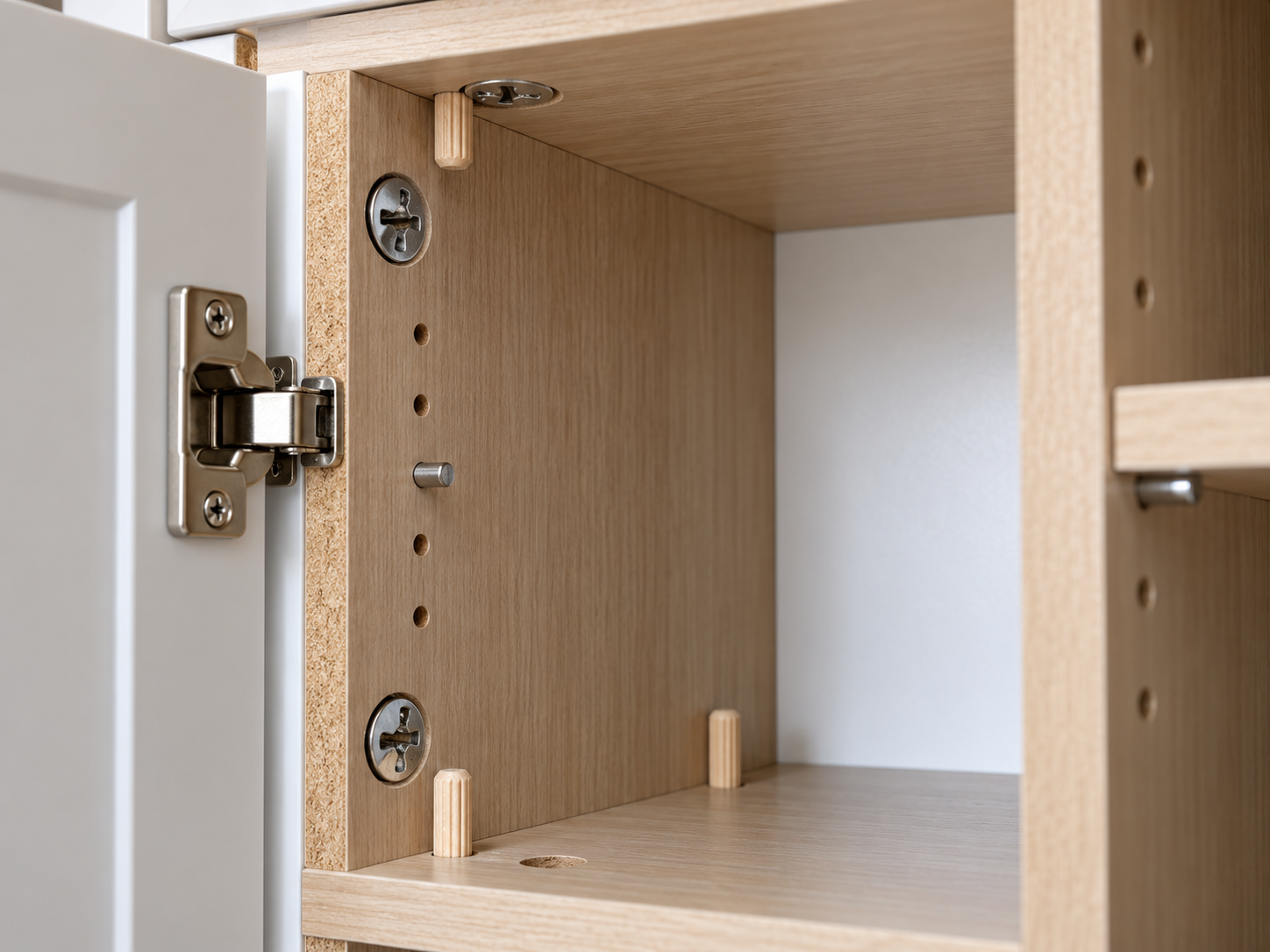
The thickness of the board in a quality kitchen cabinet is 18mm. Most contractors offer cheaper rates by using boards with 15mm or even 12mm thickness. These boards appear exactly the same externally but bend under loads and deteriorate quickly due to humidity in the kitchen. For kitchen cabinets located next to the sink or under the cooker hob, the board needs to have a moisture-resistant or E1 rating.
- Ask the contractor or sales staff to confirm the board brand and thickness in writing on the quotation.
- Knock on the cabinet side panel — a solid, dense knock indicates thicker board. A hollow echo suggests thin board.
- Check for swelling at the base of cabinets on showroom display — any expansion or bubbling at the bottom edge is a moisture failure sign.
Edge banding covers the raw cut edges of every board panel in your kitchen cabinet. In Malaysia's humid climate, this is where most kitchens fail first. When edge banding peels, moisture enters the exposed particleboard core, causing swelling, delamination, and permanent damage. This is not cosmetic — once the board core is wet, the cabinet panel cannot be recovered without full replacement.
Good quality edge banding is thick PVC tape from 0.8mm to 2mm in thickness applied with industrial hot melt glue. Paper-based thin tape or PVC tape fixed with contact adhesive will peel off in 1 to 3 years in the kitchen environment. The difference between good and inferior edge banding cannot be seen once it is installed — hence it is critical to test it during the showroom phase.
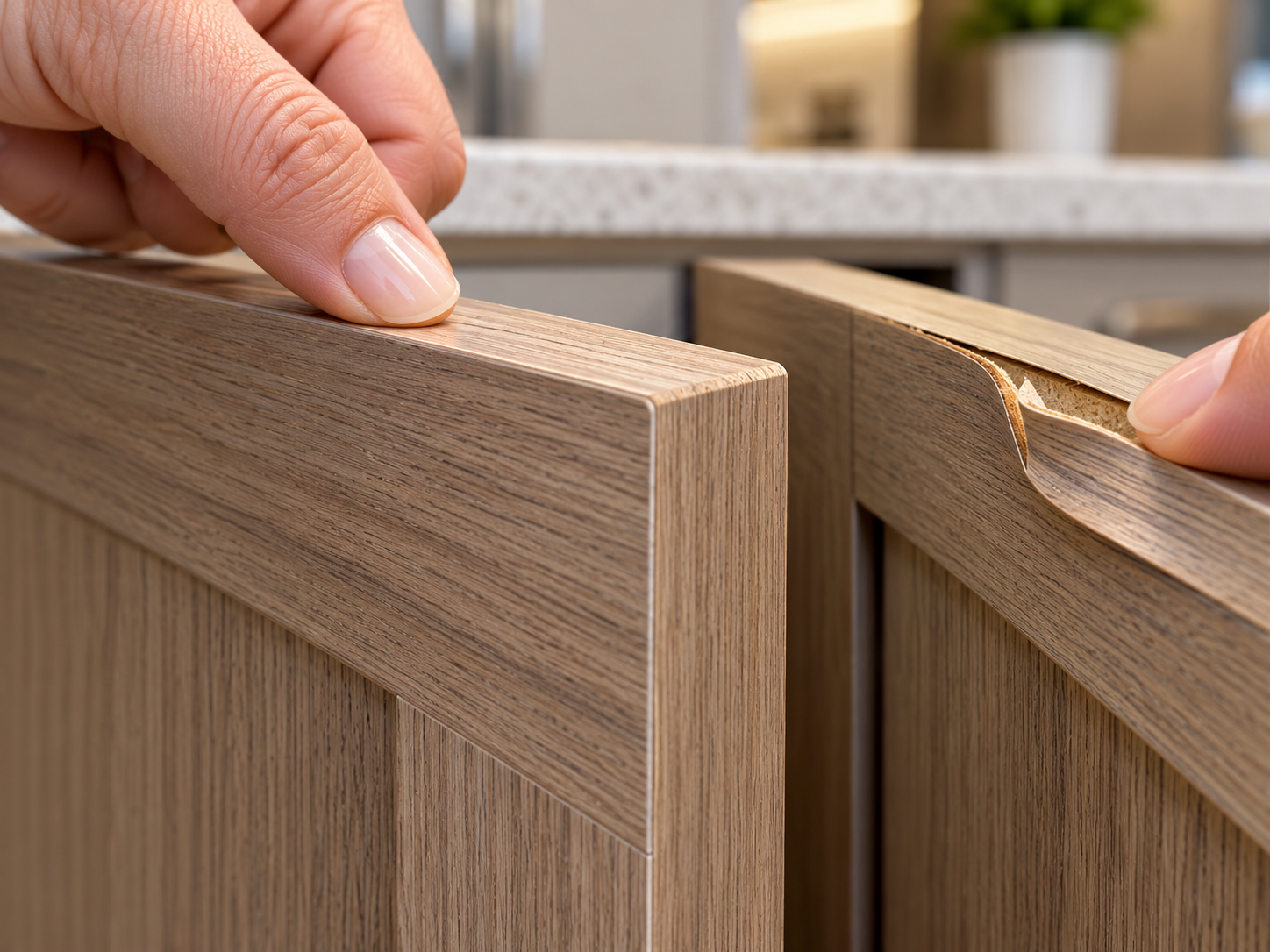
- Use your fingernail to scrape hard along all edges of the display cabinet. There should be no lifting, bending or separation of edge banding anywhere.
- Test corner joints for signs of stress — this is where bad quality edge banding becomes apparent. The joint should be perfect with no overlap or separation.
- Finger check the edge surface — it should feel flat and smooth without any bump or texture compared to the face of the cabinet.
The two companies that define kitchen hardware standards in Malaysia are Blum (Austria) and Hettich (Germany). They both provide certification for a specific number of opening cycles — a Blum CLIP top hinge is certified for 200,000 cycles of uniform performance. Generic unbranded hinges can survive only 30,000 to 50,000 opening cycles before becoming wobbly, tight, or loose — in a normal kitchen, that can mean only two to three years of average use.
Every cabinet door and drawer should open and close smoothly and uniformly, with a clear soft-close action in the last 10 to 20mm of movement. This is one of the easiest quality checks to perform in a showroom, and one of the clearest signs of better hardware.
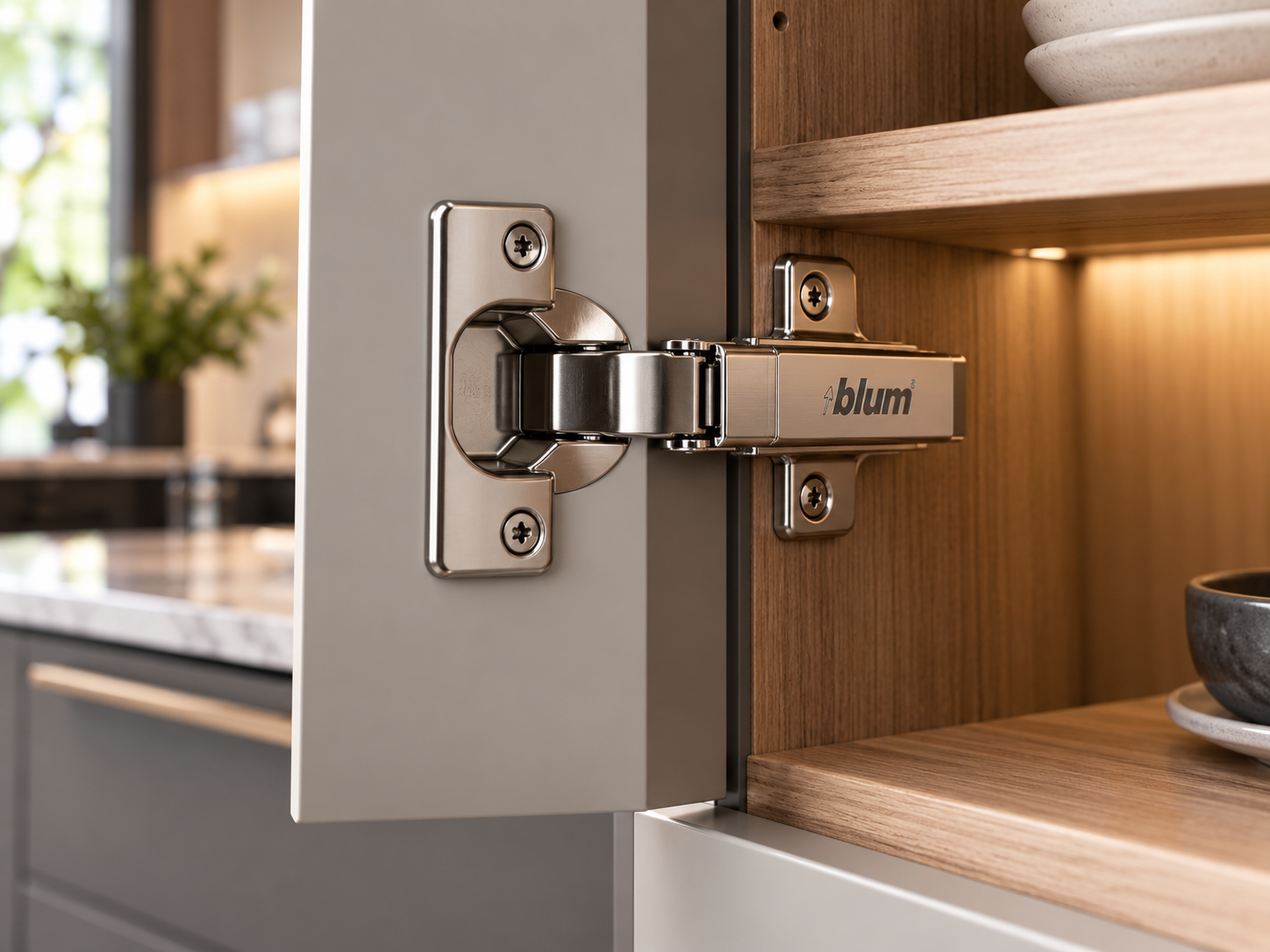
- Open and close every cabinet door and drawer. The movement should feel smooth, even, and controlled, with the soft-close action engaging consistently in the last 10 to 20mm.
- Check for the brand name on the hardware itself. The hinge or drawer system should have the brand clearly marked or moulded on the component. Blum hardware, for example, is marked with a visible "blum". Browse the full Blum product range to recognise genuine components.
- Ask the contractor to indicate the brand and model of the hinge and drawer system in the quotation. There is no reason why a contractor using genuine Blum or Hettich products should refuse this request.
Misaligned cabinet doors and drawers are the most visible quality indicator — and also a structural one. A door that is visibly crooked, a gap that widens from top to bottom, or a drawer that wobbles sideways on every open — these do not happen by accident. They indicate either poor installation technique, warped board used despite the defect, or hinges that were not properly adjusted after installation.
In a properly installed kitchen, every cabinet door should have a consistent 2mm to 3mm gap on all sides. Drawers should travel in a straight horizontal line from fully open to fully closed with no lateral movement. Checking this in the showroom tells you about the contractor's installation standard — checking it on your own kitchen within the first two weeks tells you whether a defect is going to be remedied or ignored. For context on what a good installation looks like, browse completed EverKitchen projects in our installation portfolio.
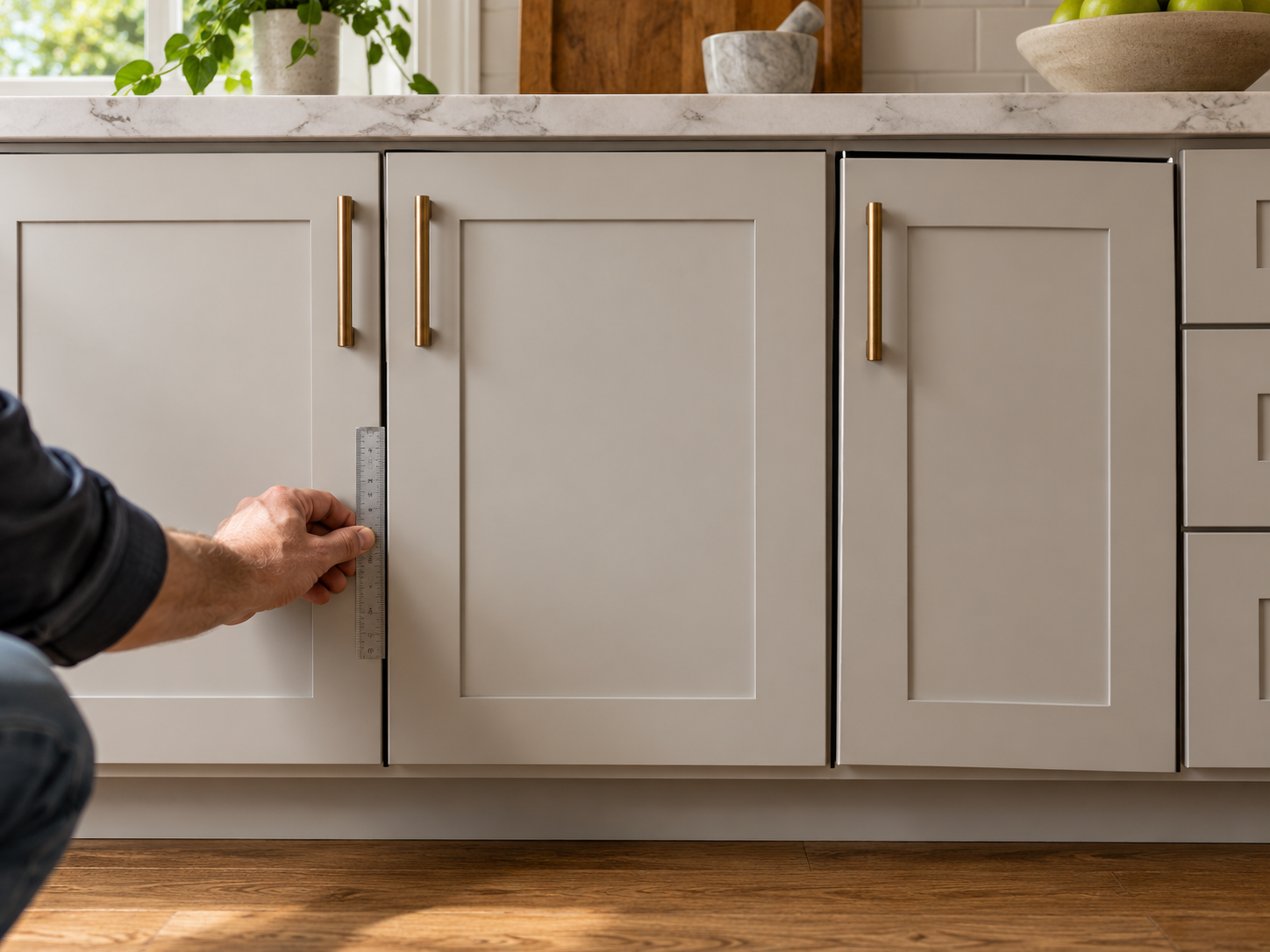
- Stand back from the display kitchen and look along the cabinet run — all door faces should be in the same vertical plane with no individual door jutting forward or recessed.
- Measure or estimate the gap between adjacent doors at the top and bottom — the gap should be identical at both points.
- Pull out a drawer slowly and watch for side-to-side movement. A quality drawer runner constrains lateral play completely.
Press hard against the back panel of a base cabinet from inside the showroom. If the thickness of the back panel is 9mm, it should feel solid. A 3mm hardboard back panel will flex visibly when pressed. This is one of the simplest ways to tell whether the cabinet uses a structural back panel or a thin cost-cutting one.
Directly ask the contractor about the thickness and material of the back panel and make sure it is stated clearly in the quotation. When installing wall cabinets above the sink, confirm the back panel is a moisture-resistant type and not normal particleboard — this location is more exposed to humidity and water splashes.
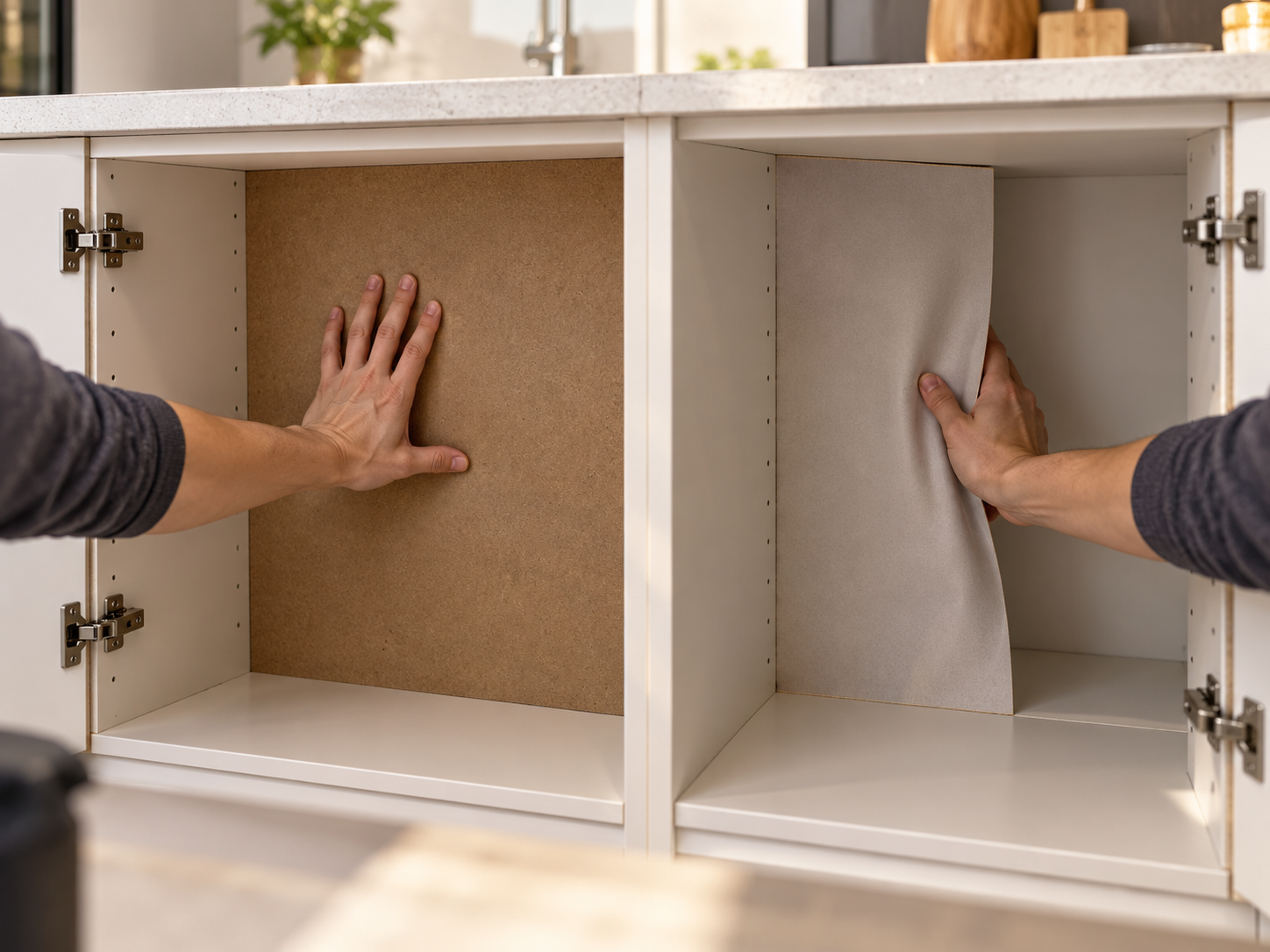
- Press firmly against the back panel from inside the cabinet. A 9mm panel should feel solid, while a thin 3mm hardboard panel will flex noticeably.
- Ask the contractor directly what thickness and material is used for the back panel, and request that it be written into the quotation.
- For wall cabinets above the sink, confirm the back panel is a moisture-resistant board and not normal particleboard.
Panel joining method and finish quality — especially at the edges, corners, and internal connection points — indicate the overall quality of the construction process. Quality cabinet construction uses cam locks together with dowels or dowel-and-glue construction with uniform spacing, creating a stiff box-like structure that does not bend or squeak in daily use.
Low-quality construction is often done using screws only, improperly installed cam locks, or glue alone. These shortcuts may not be obvious at first glance, but over time they result in cabinets that loosen, shift, or feel less solid. Neat edges, clean corners, and accurate drilling are all signs that the cabinet has been manufactured with better control and precision.
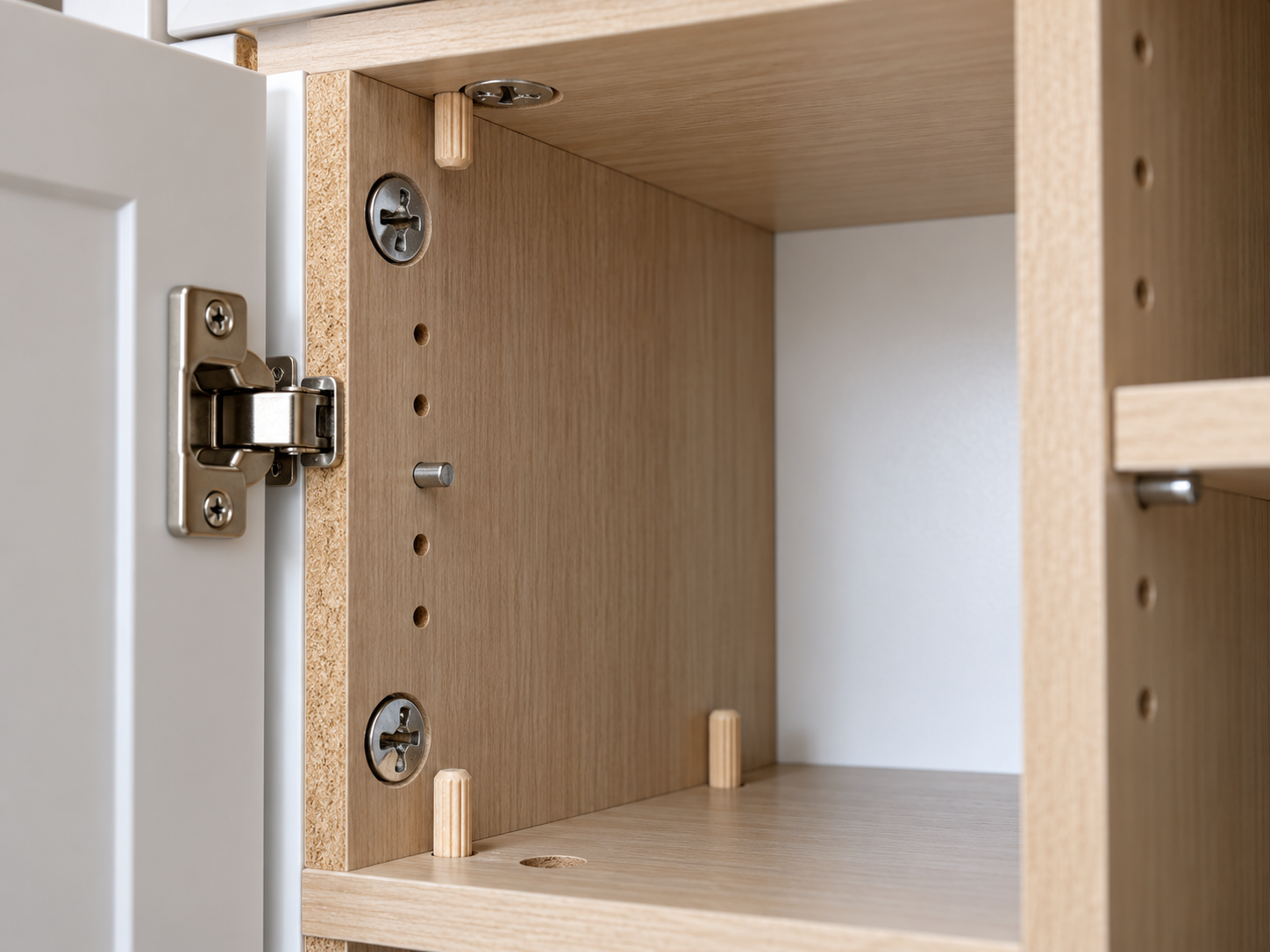
- Apply force to the cabinet carcase in various directions — it must be sturdy without any flexibility, shaking, or joint sounds.
- Inspect the inside of a base cabinet using a flashlight — there should be no bare wood surfaces visible anywhere. Bare wood on the inside or base of the cabinet is a sign of poor craftsmanship.
- Ensure that the shelf pin holes are clean, straight, and equally spaced. Poorly drilled holes mean poor quality manufacturing processes.
Kitchen cabinets displayed in showrooms have been assembled and maintained to look perfect in order to sell them. The materials used for the display cabinets might not be the same materials used for your kitchen installation. Ensure that you see a previous installation in the home of one of their clients or get material samples from the contractor. Qanvast Malaysia and Recommend.my both carry verified contractor reviews with completed project photos you can use as a reference point.
Reading a Kitchen Cabinet Quote
A quotation that does not itemise materials is not a protective document — it is a liability. If you accept a lump-sum price without material specifications, you have no contractual basis to reject substandard materials when they arrive on site. These are the five things that every kitchen cabinet quotation should state explicitly before you sign. For a complete breakdown of how kitchen cabinet pricing works in Malaysia, see our kitchen cabinet price guide for 2026.
- Board Specification Brand name, thickness in mm, and moisture-resistance grade for the carcase board. Example: "Evergreen E1 MR 18mm".
- Hardware Brand and Model Hinge brand and model number, drawer runner brand and system name. Example: "Blum Clip Top hinges, Blum Tandembox drawer system".
- Door Finish and Thickness Material type (membrane, lacquer, laminate, solid wood), thickness, and surface finish description. Colour code reference if applicable.
- Worktop Material and Thickness Brand or grade of quartz, stainless steel gauge, or solid surface specification. Edge profile type and thickness in mm.
- Scope Inclusions Delivery, installation, plinth fitting, kickboard, waste removal, and defect rectification period should all be explicitly listed as included or excluded.
Quick Reference: Pass or Fail
| What to Check | Pass Standard | Fail Indicator |
|---|---|---|
| Carcase board thickness | 18mm | 15mm or below |
| Board moisture resistance | E1 or MR rated | No rating stated |
| Edge banding adhesion | Flush, no lift at any point | Any lift, gap, or peel |
| Hinge brand | Blum, Hettich, or equivalent named brand | No brand name visible or stated |
| Drawer runner brand | Blum, Hettich, or equivalent named brand | No brand name visible or stated |
| Door gap consistency | 2mm – 3mm consistent on all sides | Over 4mm or inconsistent top to bottom |
| Back panel thickness | 9mm | 3mm hardboard (flexes under hand pressure) |
| Cabinet body rigidity | No flex or sound under hand pressure | Any movement, creak, or flex |
| Interior panel finish | Fully laminated on all surfaces | Raw board visible on interior faces |
For a deeper look at how these material choices fit into the overall cabinet selection process, see our guide on how to choose the right kitchen cabinet maker in Malaysia. For a full breakdown of board types and ratings, see our top kitchen cabinet materials guide for 2026. For current kitchen design ideas that use these materials, see our top kitchen cabinet designs guide.
Not Sure What You Are Looking At?
Bring this checklist to your next showroom visit — or let EverKitchen walk you through it. We are happy to explain exactly what materials we use, show you the specification on the quotation, and let you test everything before you decide. No pressure, no obligation.
WhatsApp EverKitchenFrequently Asked Questions
What board thickness should a quality kitchen cabinet have?
Quality kitchen cabinets should use 18mm thick boards for the cabinet body (carcase). Some budget options use 15mm or even 12mm, which reduce durability and load-bearing capacity. Always confirm the board thickness in writing before signing any contract.
How do I check edge banding quality on kitchen cabinets?
Run your fingernail along every edge. A quality edge band sits flush with the board surface, has no gaps, and does not lift. Thick PVC edge banding (0.8mm to 2mm) applied with hot melt glue resists peeling far better than thin paper tape. Check corners especially — poor banding peels here first.
Which hardware brands should I look for in kitchen cabinets?
Blum (Austria) and Hettich (Germany) are the industry benchmarks for hinges and drawer systems. These brands offer smooth operation, soft-close function, and durability rated to tens of thousands of opening cycles. Avoid cabinets with unbranded or unknown-origin hinges, as these wear out quickly and cannot be easily replaced.
What is a normal gap tolerance for kitchen cabinet doors?
A consistent gap of 2mm to 3mm between cabinet doors is acceptable and normal in Malaysian carpentry. Gaps wider than 4mm, inconsistent gaps between adjacent doors, or doors that are visibly crooked indicate poor installation or warped boards. Drawers should open and close in a straight line without any side-to-side wobble.
Do I need to check the cabinet back panel?
Yes. The back panel is one of the most commonly cut-corner areas in budget cabinets. It should be at least 9mm thick. Thin 3mm hardboard back panels flex, bow, and cannot support the weight of items pushing against them from inside. For cabinets mounted near water sources, confirm the back panel is also moisture-resistant.
What should I look for in a kitchen cabinet quotation?
A trustworthy quotation should itemise board brand and thickness, edge banding specification, hardware brand and model, worktop material and thickness, and whether installation, delivery, and waste removal are included. A single lump-sum price with no material breakdown is a red flag — you cannot verify what you are actually paying for. Our kitchen cabinet price guide explains how to read and compare Malaysian renovation quotes in detail.