The TV cabinet is the first item that visitors see as they enter most Malaysian homes. It acts as a focal point for the living room, setting the mood for the entire interior design and, in many cases, it holds all of the components of the entertainment setup in the home, including consoles and set-top boxes and anything else that belongs close to the TV. Designing such a cabinet involves striking a balance between appearance, storage, and appropriate scale for a Malaysian living room.
This guide covers the TV cabinet designs that work best in Malaysian homes - from compact condo units to spacious double-storey landed homes - with practical guidance on sizing, materials, built-in versus freestanding, and what to specify before you commit to a contractor. For design ideas across the full home, visit our project portfolio to see completed EverKitchen installations.
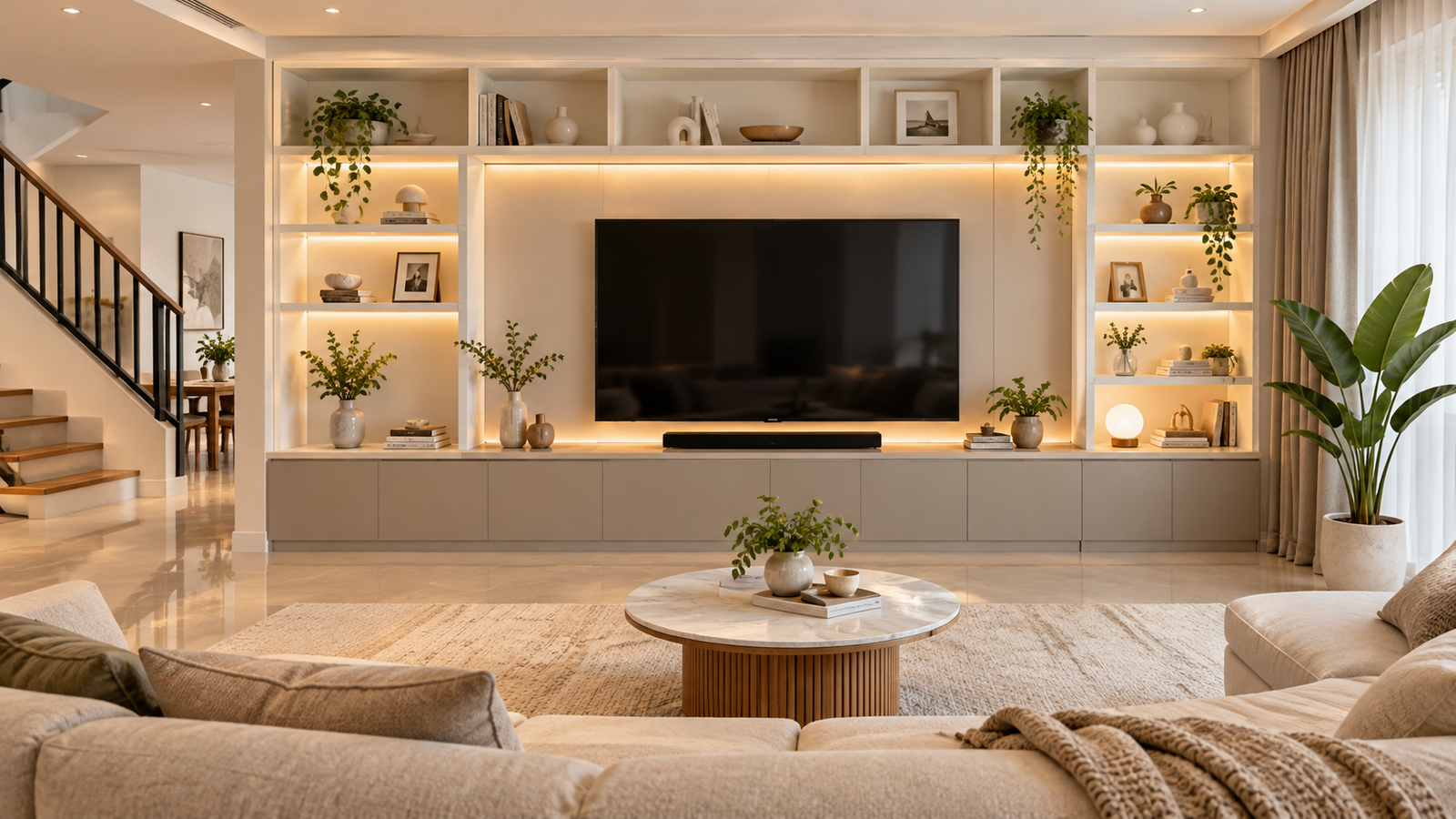
- Full-wall feature walls offer optimal storage space while serving as an attractive focal point for the living room. They are most suitable for large Malaysian houses and spacious condominiums.
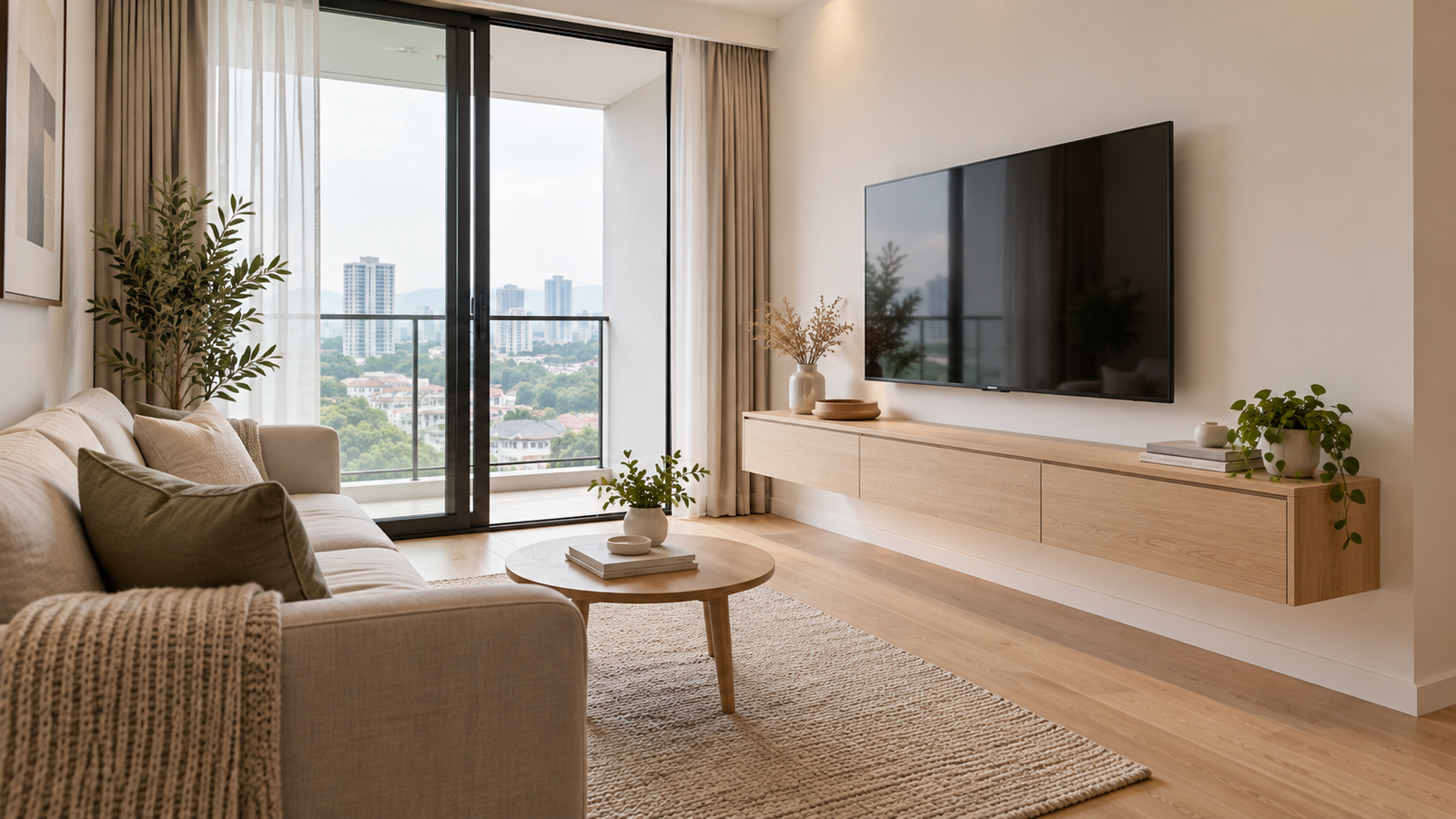
- Floating wall-mounted TV units are great choices for smaller condominiums and apartments since they don't clutter the floor.
- Fluted panel feature walls and Japandi low consoles are among the top trends in TV cabinets for Malaysian homes in 2026.
- TV cabinet height matters. A typical cabinet height of 400mm to 500mm helps position the TV closer to a comfortable seated eye level.
- Built-in TV cabinets provide more integrated storage and a cleaner overall look, while freestanding consoles offer greater flexibility for renters or homeowners who may want to rearrange the room later.
- Concealed cable management should be planned early. Confirm power, HDMI and device-routing requirements before fabrication begins to avoid visible wiring or costly modifications later.
TV Cabinet Ideas by Malaysian Home Type
The right TV cabinet design depends heavily on the type of home you live in. A solution that works beautifully in a Klang Valley condominium is completely wrong for a Selangor double-storey terrace house, and vice versa. Here is how to approach the design by home type. For real Malaysian home renovation photos by home type, Qanvast Malaysia is a useful visual reference.
- Floating TV unit at 350mm to 400mm from floor - clears floor entirely
- Full-width low console running wall to wall - unifies the space
- Light-toned materials - white, greige, or light oak
- Minimal upper shelving - keeps walls open and airy
- Integrated LED strip lighting under the floating unit
- Floor-to-ceiling feature wall with mix of closed and open storage
- Combination of cabinet base and floating shelves above TV
- Warm timber tones, fluted panels, or textured back panel
- Built-in display niches for decor and family photos
- Integrated audio system housing with ventilation gaps
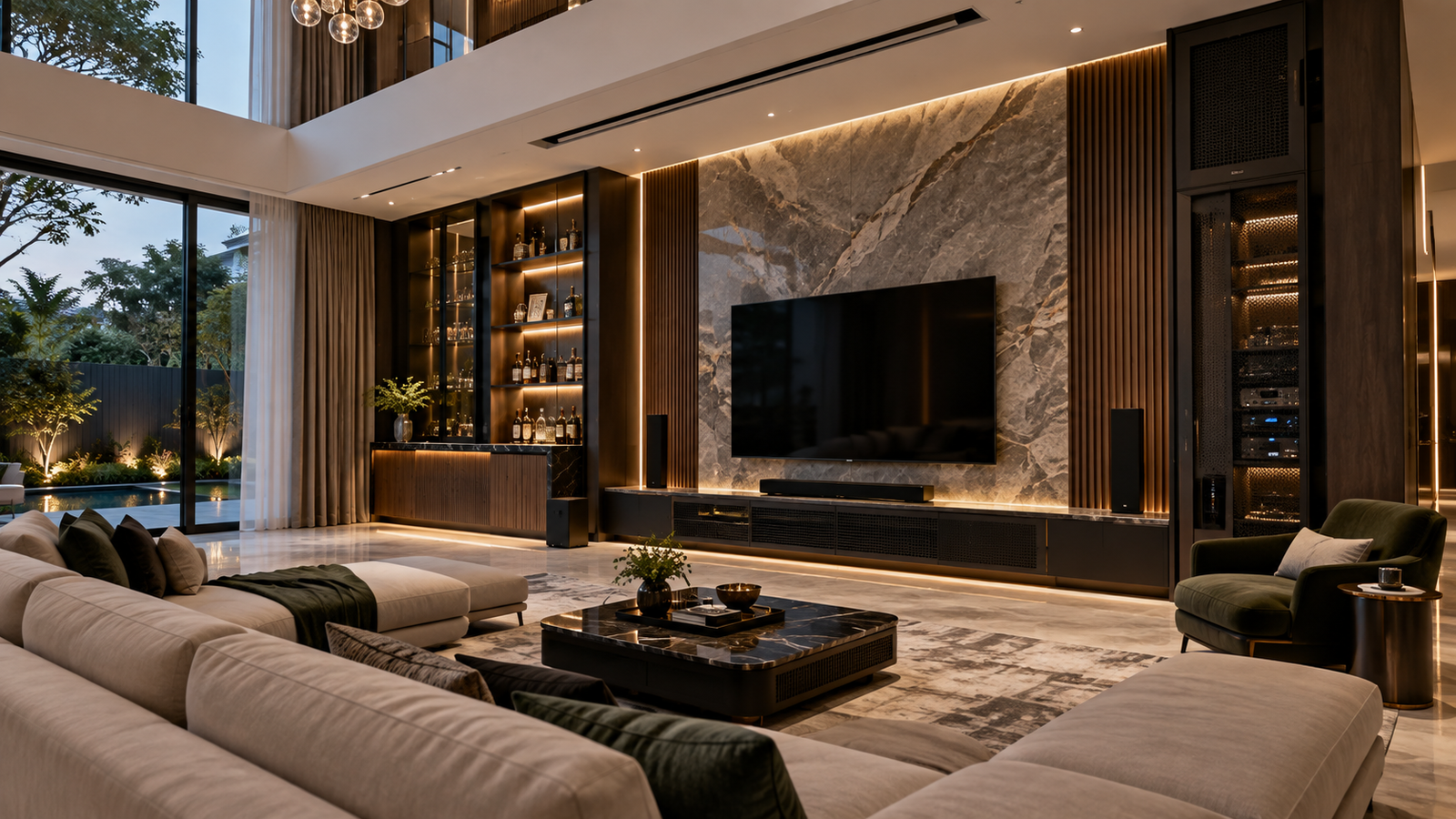
- Full-height feature wall with stone, fluted panel, or veneer backdrop
- Integrated bar or display unit alongside the TV wall
- Dark tones - charcoal, walnut, deep green - work in larger spaces
- Hidden projector screen housing built into ceiling soffit
- Dedicated AV equipment cabinet with ventilation and cable routing
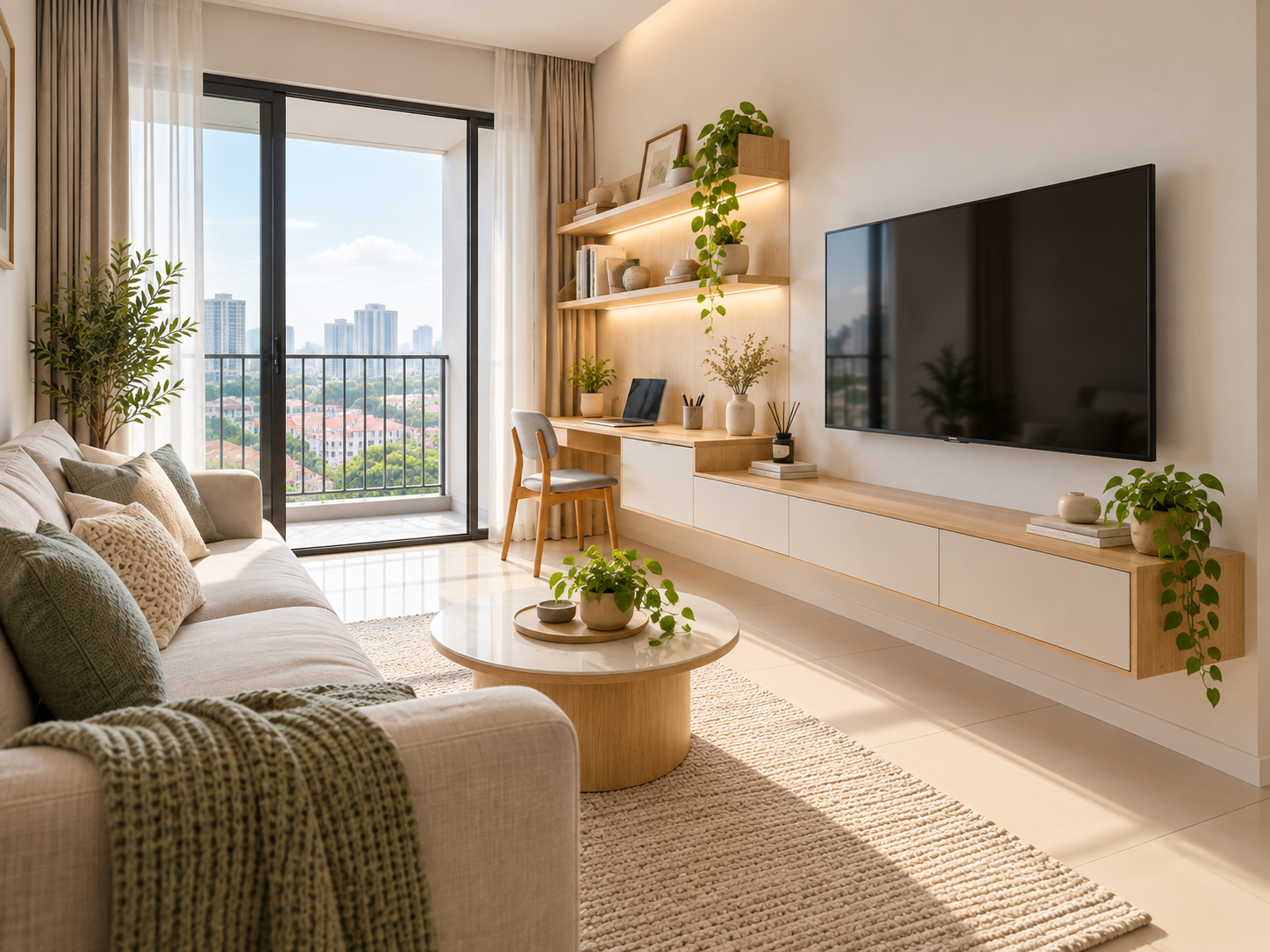
- Simple floating TV unit with closed storage below
- Avoid floor-to-ceiling designs that overwhelm the space
- Light colours throughout - white or off-white
- Multipurpose design - TV unit doubles as study or display storage
- Budget: RM2,500 to RM5,000 built-in range
Top TV Cabinet Design Ideas for Malaysian Homes in 2026
The full-wall TV feature wall runs the entire width of the living room wall from floor to ceiling, combining a base of closed cabinets for storage with open shelving above for display. The TV is positioned at the centre of the composition, with the upper wall treatment creating visual height and framing the screen. This is the design that dominates Malaysian living room renovations in 2026 because it solves two problems simultaneously - it provides generous storage for the household and creates a finished, designed focal point for the living room without requiring any additional furniture.
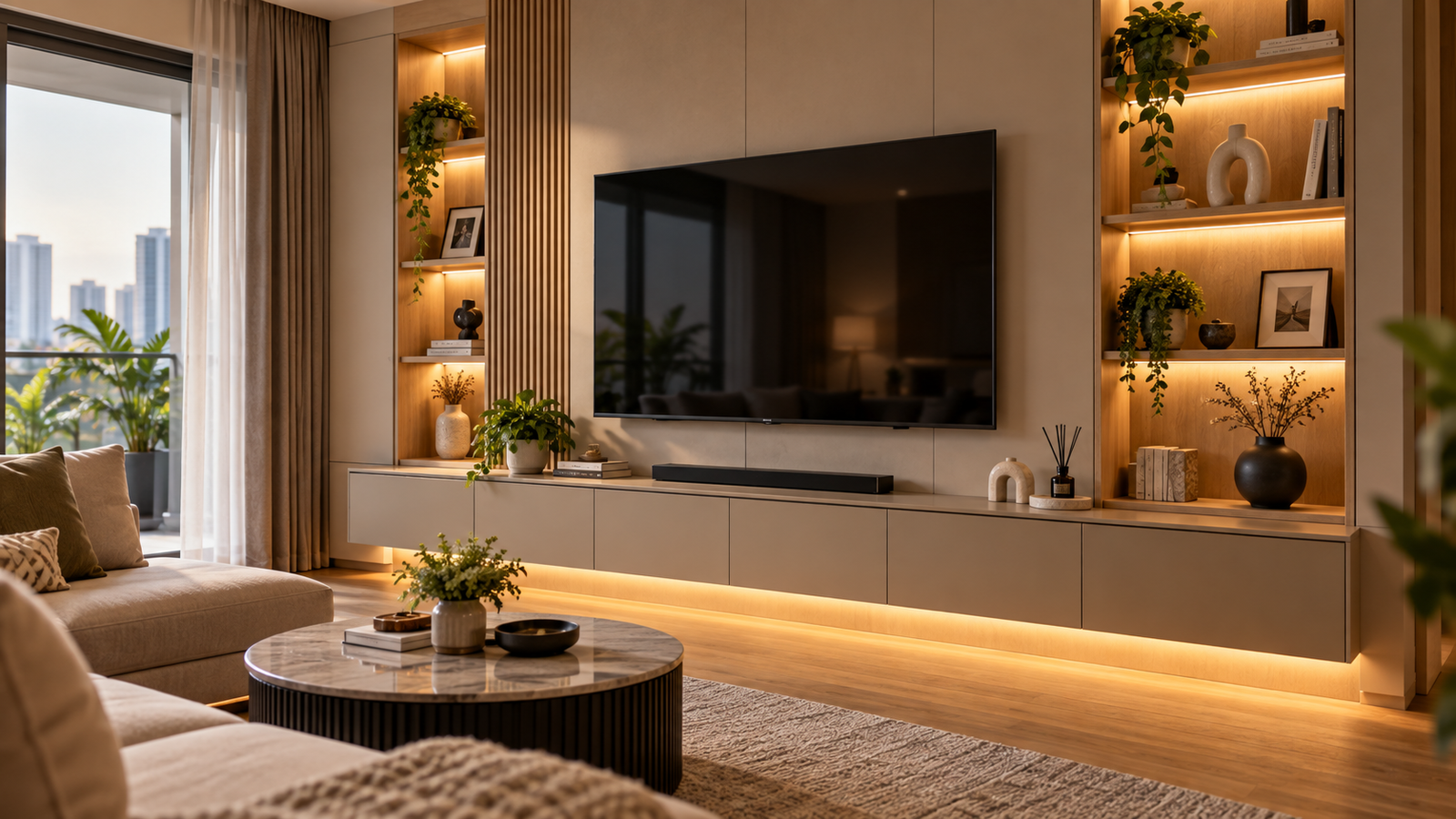
The key to this design is the balance between closed and open storage. Too much closed storage creates a heavy, box-like wall. Too much open shelving creates a cluttered, maintenance-intensive display. The most successful Malaysian versions use closed cabinets for approximately 60% of the lower wall area and open display niches for the upper section, with the TV positioned at a natural break between the two zones.
A floating TV console is wall-mounted at 350mm to 400mm above the floor, leaving the entire floor area clear and creating a strong visual sense of space in compact Malaysian living rooms. The console provides storage - drawers, closed compartments, or a combination - while the wall above is typically used for the TV mount and minimal wall decoration rather than built-up shelving. This design reads as clean and contemporary, which is why it is particularly popular in Malaysian condo units where the minimalist aesthetic is strongly favoured.
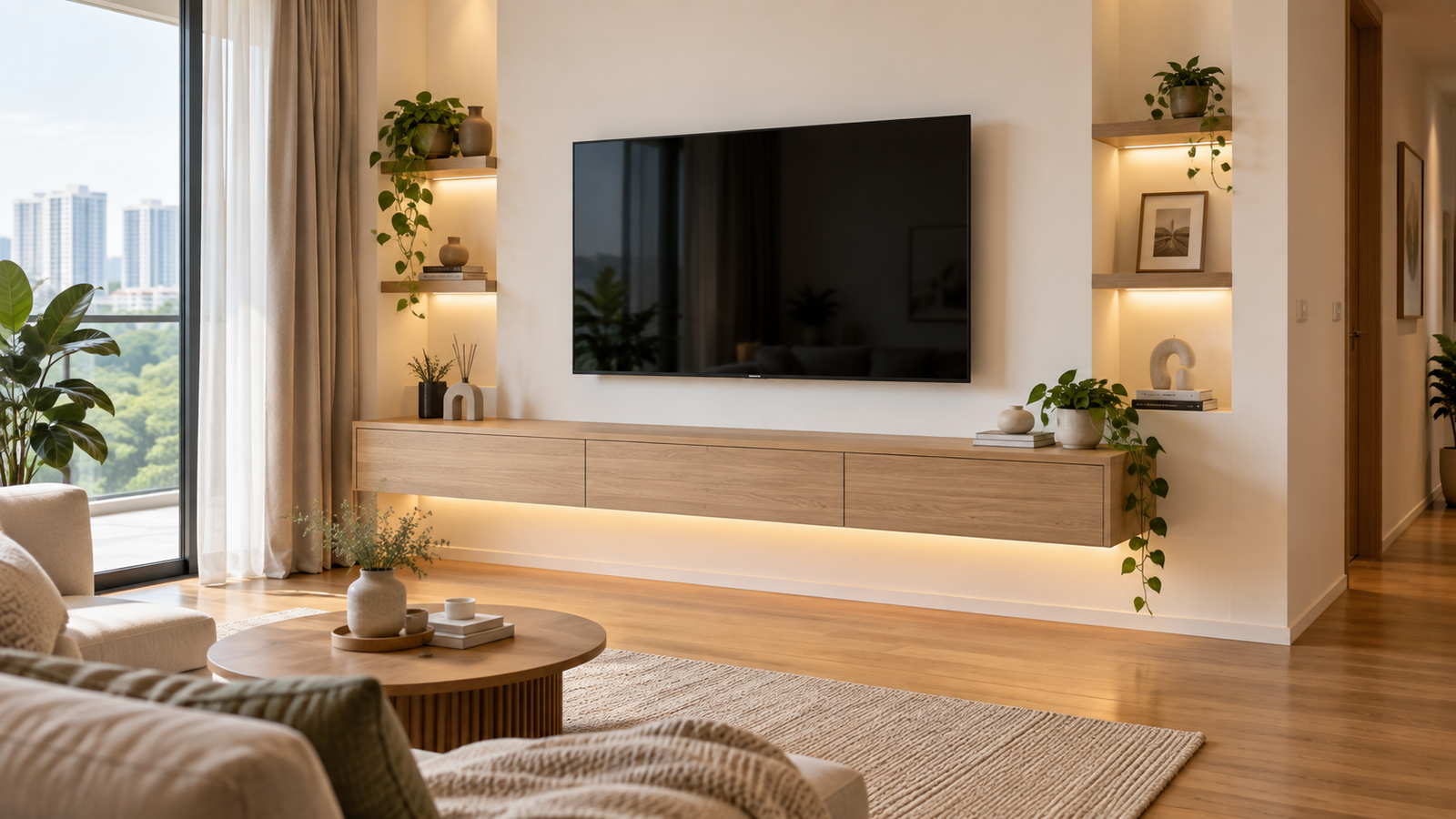
The structural consideration in Malaysian homes is important here - the floating console must be mounted into the structural wall, not just the render or drywall. In condos where the TV wall is a non-structural partition, a carpenter or contractor must locate and bolt into the concrete columns or use a heavy-duty wall anchor system rated for the weight of the console plus its contents. Confirm this before fabrication begins. For more on what to lock in before your renovation starts, see our renovation planning checklist.
Fluted panels - vertical grooved boards with a ribbed texture surface - have become the most popular new material used in the Malaysian TV feature walls in 2025 and 2026. They provide texture without color, so they fit into any color scheme and look much more sophisticated than just painted wall. Usually, the TV is mounted to the wall on the fluted panels and cable management is placed behind the panel layer.
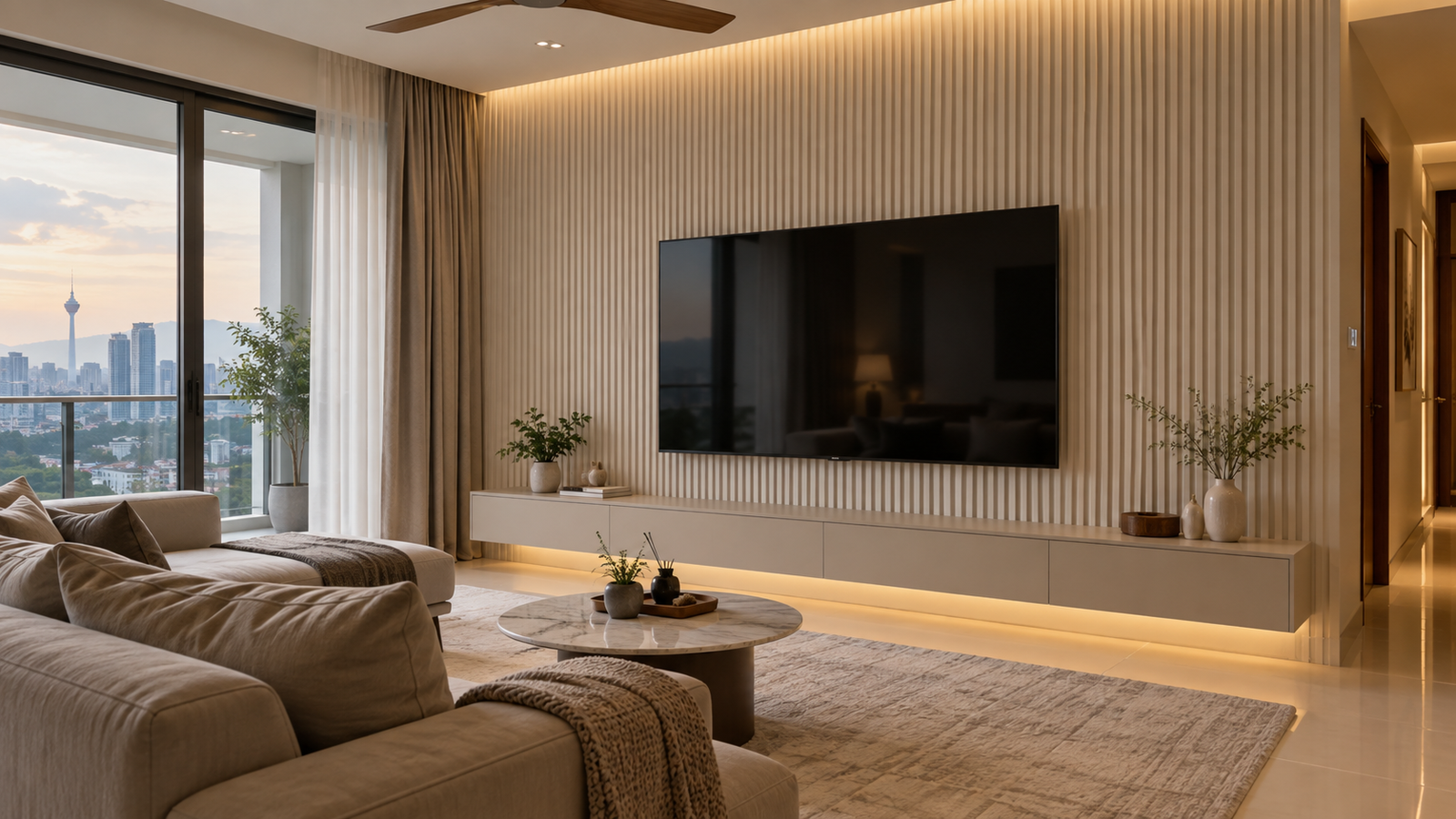
Fluted panels can be made of PVC, MDF, solid wood and engineered wood veneer. The most durable and easy to maintain are PVC fluted panels that are most resistant to moisture and therefore best suited for Malaysian humidity. But solid wood panels are the most premium ones, but need to be sealed properly to prevent warping in an air conditioned room. The fluted panels cover the whole TV wall and usually combined with a floating TV console below and hidden LED strip lights above the TV.
Combination of minimalist Japanese style and cozy Scandinavian style, known as Japandi, is one of the most sought-after interior design styles among Malaysian houses over the last couple of years. This type of style used for the TV cabinet will result in the creation of a flat console table in light oak or warm wood finish, with flat-front drawers or sliding doors without any handles, taking minimal space on the wall. The TV itself is attached directly to the wall, not on the console, while the wall around is almost empty except for some chosen decor items.
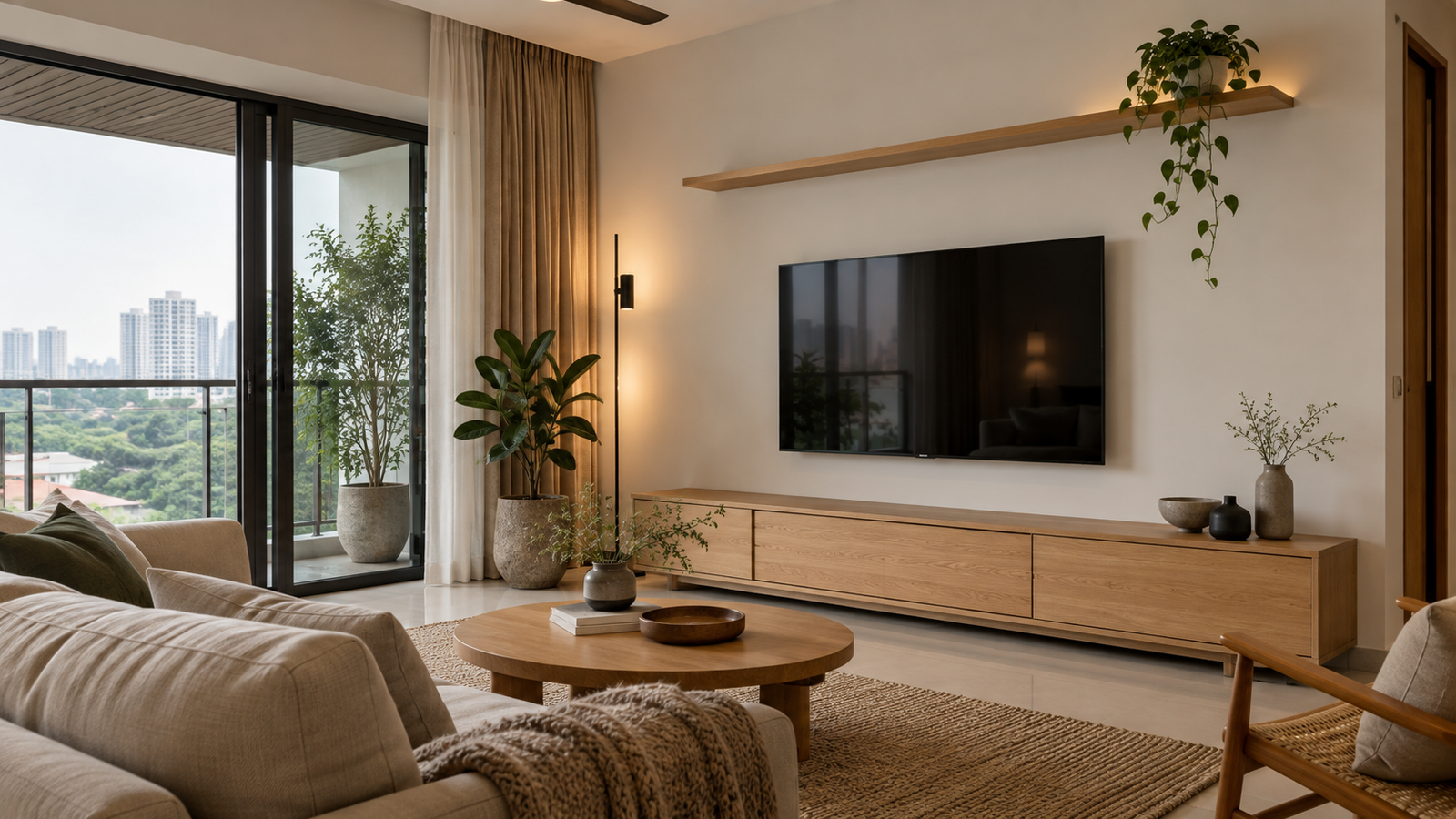
This design works particularly well in Malaysian condos where the living room also connects to an open dining area - the low, calm presence of a Japandi TV console does not compete visually with the dining furniture or kitchen in the way that a tall feature wall does. The material palette is typically natural timber, white or cream walls, and matte black or brushed brass hardware. For homeowners drawn to this aesthetic across the full home, it pairs naturally with our kitchen cabinet design guide which covers warm-contemporary cabinet styles in detail.
Two-tone TV cabinets use different colours or finishes on the upper and lower sections of the TV wall, creating visual layering that makes a standard living room feel more considered and designed. The most common Malaysian combination in 2026 is white or cream upper shelving with warm oak or greige lower cabinets - the same palette logic that is driving popularity in Malaysian kitchen design. The lighter upper section keeps the eye level bright and open while the slightly richer lower section anchors the composition.
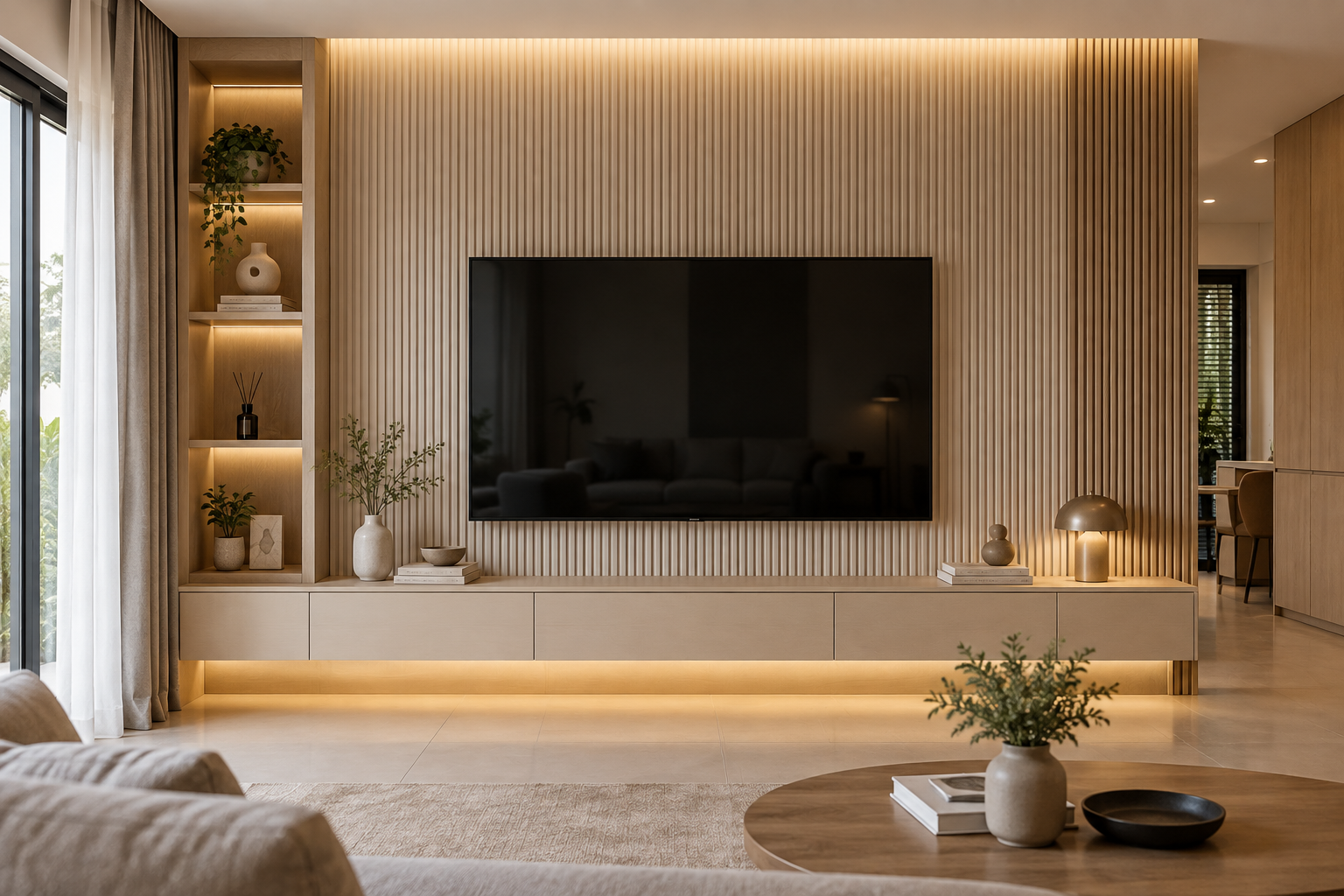
A second popular combination is a dark feature panel or wall behind the TV itself - charcoal, deep green, or dark navy - with white or neutral cabinets on either side. This creates a strong focal point around the screen without darkening the entire room. This approach works particularly well in larger living rooms where the TV wall is far enough from the seating area that the dark panel does not feel overwhelming.
An increasing number of Malaysian landed homeowners are replacing the traditional TV wall with a hidden projector setup - a ceiling-mounted or recessed projector that deploys onto a motorised retractable screen, with the screen housing concealed inside a ceiling soffit or cornice detail when not in use. When the screen is retracted, the wall in front of it is a clean, uninterrupted feature wall. When deployed, the living room becomes a cinema space with a screen width of 100 to 150 inches.
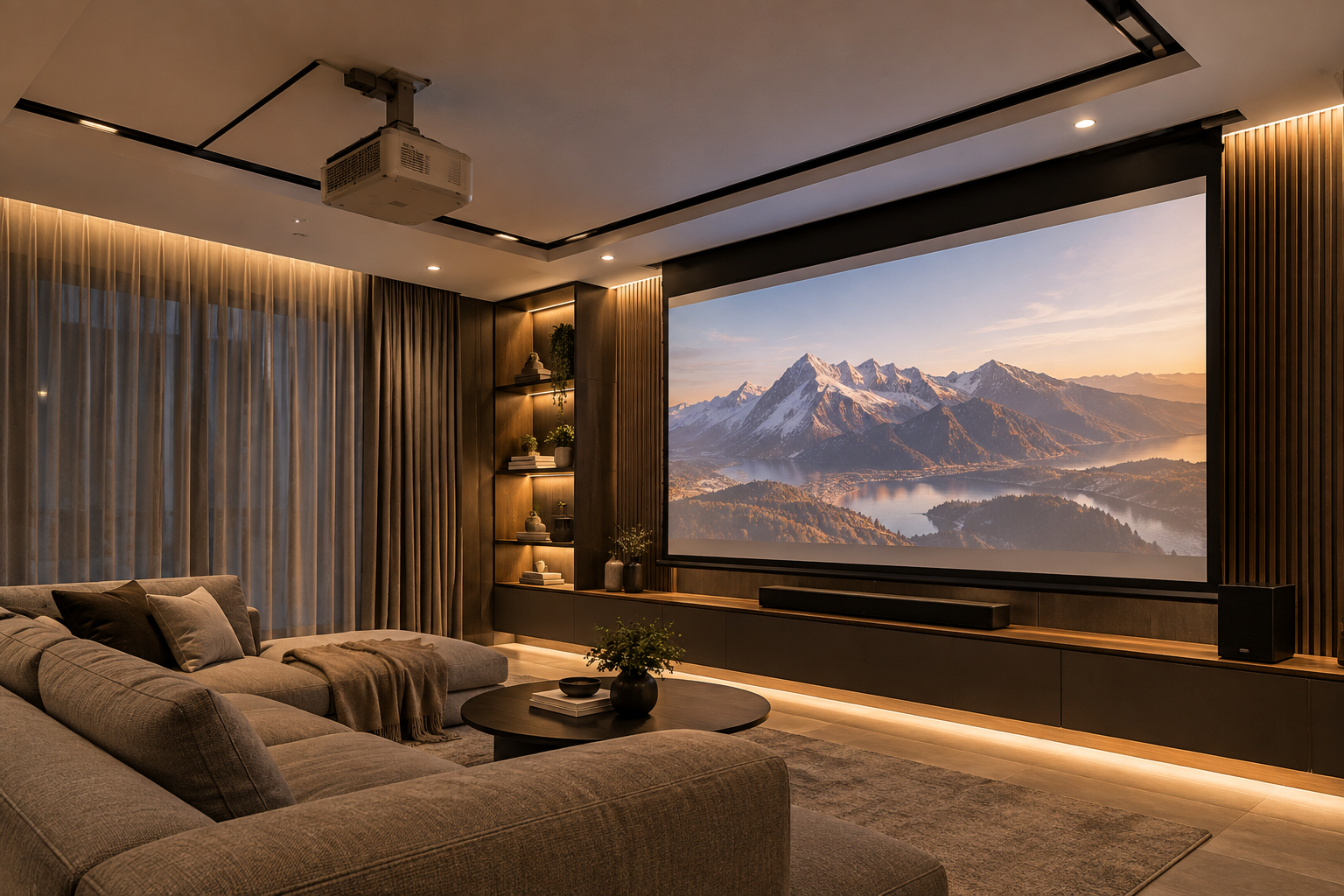
This particular setup will require ceiling height of 2.8 meters at least to allow the proper size of the screen and projection distance - it is suitable for two-story terrace and semi-detached homes, but seldom possible in normal Malaysian condominium units. The projector may be mounted on the ceiling in a properly vented box, or installed inside a carpentry-made box that will look like the rest of the ceiling surface. The TV cabinet under the screen is kept to hold the set-top box and media, or substituted with a credenza for the same purpose.
What to Confirm Before Your TV Cabinet Is Built
Most Malaysian TV cabinet renovations run into the same set of avoidable problems - problems that are easy to prevent if the right questions are asked before the carpenter starts work. Here is what to lock in.
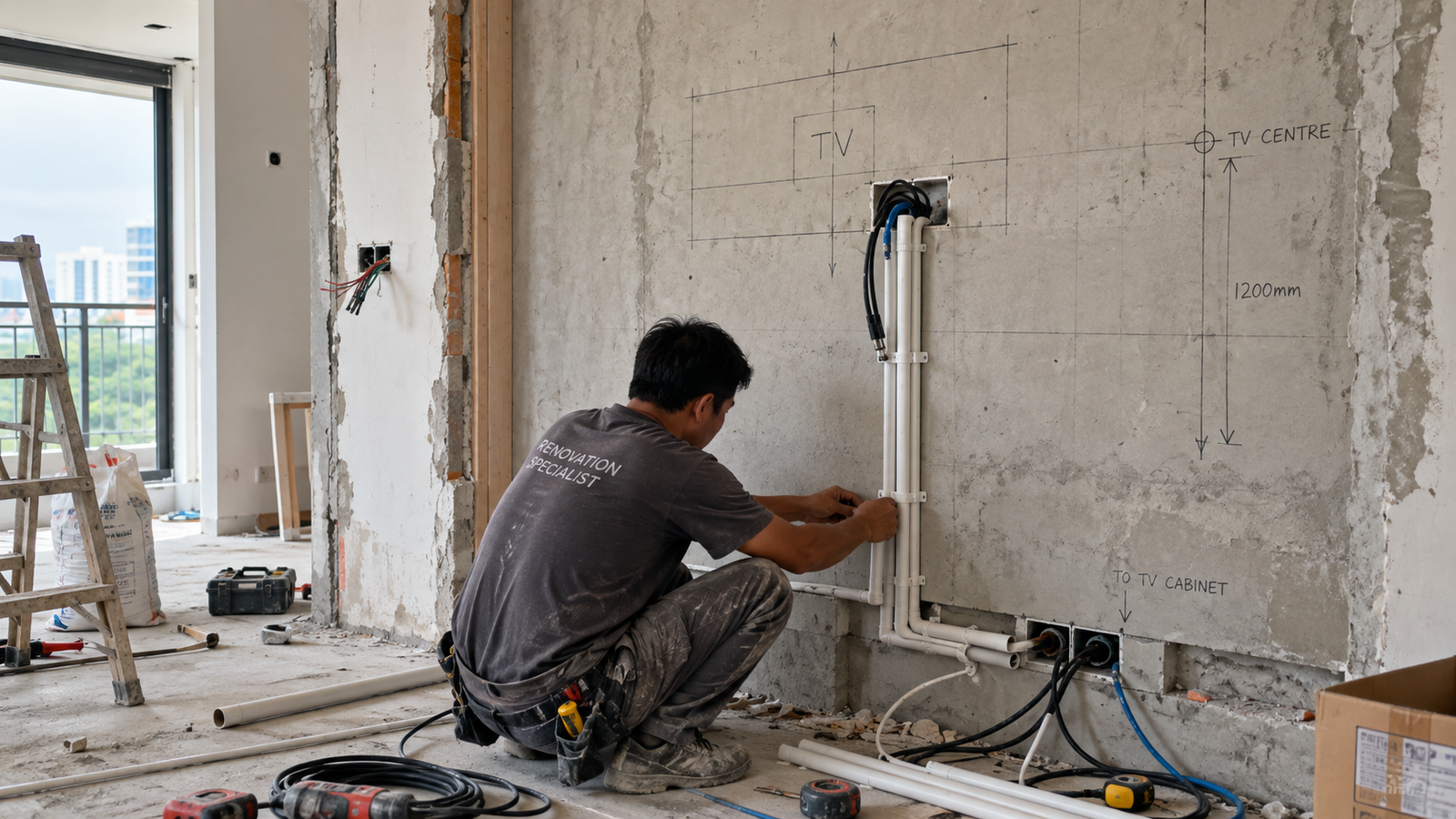
- Cable Management - Plan Every Wire Route Before Fabrication Concealed cable management is the most commonly regretted omission in Malaysian TV cabinet renovations. Once the cabinet is built, retrofitting concealed conduit for HDMI, power, and aerial cables requires cutting into walls or living with visible cable runs. Before fabrication, map every device that will be connected to the TV - set-top box, soundbar, gaming console, Unifi router, streaming device - and confirm with the carpenter where each cable enters and exits the cabinet. A conduit pipe through the wall behind the TV mount point to the equipment cabinet below should be a standard inclusion in any TV wall design.
- TV Mount Position and Weight Rating The TV mount position must be confirmed before the feature wall panels are installed. Once panels are up, adding or moving a mount requires drilling through the finished surface and potentially relocating a wall anchor. Confirm the TV size, weight, and mount type - fixed, tilt, or full-motion - before work begins, and ensure the mount is bolted into a structural element behind the panel, not just into the panel itself.
- Power Outlets Inside the Cabinet All set-top boxes, soundbars, gaming consoles, and streaming devices need power. A power outlet inside the equipment storage section of the TV cabinet - accessible when the cabinet door is open but hidden from the living room - keeps all visible power strips off the floor and out of sight. This requires an electrician to install before the cabinet is fitted. Confirm the number of outlets needed based on your actual device list, not a general estimate.
- Ventilation for AV Equipment Set-top boxes, game consoles, and AV receivers generate heat. A closed cabinet with no ventilation will cause equipment to overheat and shut down - or in severe cases, reduce the lifespan of the equipment significantly. If your TV cabinet design includes a closed compartment for electronics, specify ventilation gaps at the back panel, a louvred door or mesh insert on the door front, or an active ventilation fan. This is particularly important in Malaysian homes where the ambient temperature inside a closed cabinet can reach 35 to 40 degrees Celsius.
- LED Strip Lighting Circuit Integrated LED strip lighting - under a floating console, inside display niches, or behind the TV as bias lighting - requires a 240V circuit brought to the right position before the cabinet is installed. Confirm whether you want LED strips included in the design and ensure the electrical circuit is in place before carpentry work begins. Retrofitting LED lighting after the cabinet is built requires surface-mounted wiring runs that compromise the clean finish.
TV Cabinet Cost Guide for Malaysian Homes
| Design Type | Typical Size | Budget Range | Includes |
|---|---|---|---|
| Simple floating console | 8 to 10 feet | RM2,500 to RM4,500 | Console unit, TV mount backing, basic cable routing |
| Full-wall low console | 12 to 16 feet | RM4,000 to RM7,500 | Wall-to-wall console, closed storage, TV mount |
| Fluted panel feature wall | 12 to 16 feet | RM4,500 to RM9,000 | Panel, console, cable concealment, LED strip |
| Full-height feature wall | 12 to 18 feet | RM7,000 to RM15,000 | Floor-to-ceiling cabinets, display niches, TV mount |
| Japandi console + minimal wall | 10 to 14 feet | RM3,500 to RM7,000 | Custom timber console, TV wall mount, minimal shelving |
| Hidden projector setup | Full living room | RM10,000 to RM25,000 | Projector, screen, ceiling housing, carpentry, electrical |
Want a TV Cabinet Design Tailored to Your Home?
Visit our showrooms in PJ, Subang Jaya, or Kajang to see material samples and discuss your living room layout with our design team. No commitment required.
Chat With Our Design TeamFrequently Asked Questions
What is the best TV cabinet design for a small Malaysian apartment?
A floating wall-mounted TV console at 350mm to 400mm from the floor is the most effective choice for small Malaysian apartments. It clears the floor entirely, makes the room feel more spacious, and allows the TV to be set at precisely the right viewing height. Pairing it with a slim full-height panel on either side adds visual balance without adding floor footprint. Keep upper wall treatment minimal - one or two floating shelves rather than a full built-up unit - to maintain the open feel.
What is the standard height for a TV cabinet in Malaysia?
The standard TV cabinet height in Malaysia is 400mm to 500mm from floor to cabinet top, which positions the centre of a 55 to 65-inch TV at approximately 900mm to 1,050mm from the floor - the correct seated eye level for a standard sofa. Floating consoles are typically installed at 350mm to 400mm above the floor for the same outcome. Always check by sitting in your actual sofa position and confirming the TV centre height before the carpenter marks the wall.
Should I choose a built-in or freestanding TV cabinet for my Malaysian home?
Built-in TV cabinets are the better long-term investment for homeowners - custom-fitted, more storage, and better visual integration at the same price point. Freestanding consoles are better for renters who cannot do carpentry work, or homeowners who want flexibility to rearrange or upgrade without committing to a fixed design. Built-in cabinets require 4 to 6 weeks of fabrication time; freestanding consoles can be purchased and installed in a day.
What materials are best for TV cabinets in Malaysia?
For Malaysian living rooms, melamine-coated particle board or MDF is standard for built-in cabinets, solid timber or veneer for premium warm-aesthetic designs, and PVC fluted panels for feature wall treatments. The key consideration is humidity - all wood-based materials should be properly sealed and edge-banded. For the board specification, E0 or E1 grade is recommended for formaldehyde control in enclosed living spaces. Avoid solid timber in direct air-conditioning airflow as thermal cycling causes cracking over time.
How much does a built-in TV cabinet cost in Malaysia?
A built-in TV cabinet in Malaysia typically costs between RM3,000 and RM15,000 depending on size, materials, and design complexity. A simple floating unit with storage for a standard 12-foot wall runs RM3,000 to RM5,000. A full feature wall with shelving, display niches, cable concealment, and LED lighting runs RM7,000 to RM15,000. Always compare quotes that specify the same board brand, grade, and hardware - a lower quote using unspecified materials is not a fair comparison.
What TV cabinet design is popular in Malaysia in 2026?
The most popular TV cabinet designs in Malaysian homes in 2026 are the full-wall feature wall combining closed lower storage with open display shelving above, the Japandi-influenced low floating console with warm timber tones, and the fluted panel feature wall using vertical grooved panels as a textured backdrop. Two-tone designs combining white or greige lower cabinets with warm oak upper panels are also strongly trending, particularly in new Klang Valley condominium units.