The board you select for your cabinetry is, by far, the most important structural decision you will make in your kitchen renovation project. Your cabinets' longevity, resistance to humidity and ability to maintain their shape for decades to come depend on your choice.
There are two major materials for making the body of your cabinets in Malaysia: plywood and melamine particleboard. The dispute about which one to pick usually comes up at every kitchen renovation consultation we provide at EverKitchen. This guide dispels the marketing fog surrounding these two materials and offers a completely unbiased comparison from the point of view of a Malaysian homeowner, considering such criteria as longevity, resistance to humidity, structural properties, cost and value for money. To learn more about how to use this information in the larger context of your renovation project, see our guide to buying kitchen cabinets.
- Plywood and particleboard have an indistinguishable appearance; however, the difference is in their internal structure, which becomes evident many years later when inferior boards begin to deteriorate.
- Plywood is stronger, holds screws better, does not warp and performs well in humid conditions, making it the preferable material for Malaysian kitchens in general.
- The moisture-resistant (MR) E1-grade melamine particleboard is an economical solution for use in dry zones of kitchen, especially when it is not possible to pay for the entire plywood package.
- There is a difference of 20% to 40% in cost between plywood and melamine cabinets on the total cabinet package; however, due to higher durability of plywood, the yearly cost is lower.
- In the case of wet kitchens of Malaysian apartments, where high temperatures, cooking steam and water splashes prevail, plywood should be chosen over any grade of particleboard.
- The compromise solution favoured by experienced Malaysian contractors uses melamine particleboard for cabinet carcasses and plywood for doors and drawer fronts, saving 20% to 30% versus all-plywood while preserving strength where it is most visible.
What Is Plywood and Melamine Board?
Plywood is made from thin layers (plies) of real wood veneer glued together with each layer's grain running perpendicular to the next. This cross-grain structure is the source of all its strength: it resists warping, splitting, and moisture movement in a way that no compressed wood chip product can match. Plywood is sold as flat sheet material and used to build cabinet carcasses, doors, and drawer fronts.
Melamine board (also called particleboard or chipboard) is made from compressed wood chips, sawdust, and synthetic resin, coated with a melamine resin paper that gives it a smooth, consistent surface. Particleboards without any treatment are very susceptible to moisture, and this cannot be understated when one considers the situation in Malaysia. Any exposure to water on an unprotected side of a particleboard results in swelling: the board expands, the surface peels off and the structural integrity of that part is completely gone. This is why the type of particleboard used and the quality of edge treatment are the most significant factors to consider when receiving melamine cabinet quotes.
Moisture Resistant (MR) particleboard uses a special resin as a binding material that delays the water absorption process in comparison with the standard particleboard. The minimum acceptable level for kitchen cabinets in Malaysia is E1 grade MR board, especially for base cabinets close to the sink and hob. Check the specification of the board and look for the E1 mark, which also implies a low level of formaldehyde emission. European-certified boards from brands like Egger, Pfleiderer, and Kronospan distributed in Malaysia meet this standard reliably.
The other important quality indicator is edge banding. The edges of particleboard are the main sources of moisture entry, and the quality of edge banding used on all cut edges decides the longevity of melamine cabinets in Malaysia. 2mm thick ABS edge banding applied with hot melt adhesive and properly trimmed is far more moisture-resistant than 0.4mm thin PVC tape, which is commonly used to cut costs. Press the edge banding on any display cabinet: if it bends or has any gap at the corner, it will absorb moisture.
Plywood Kitchen Cabinets: A Detailed Look
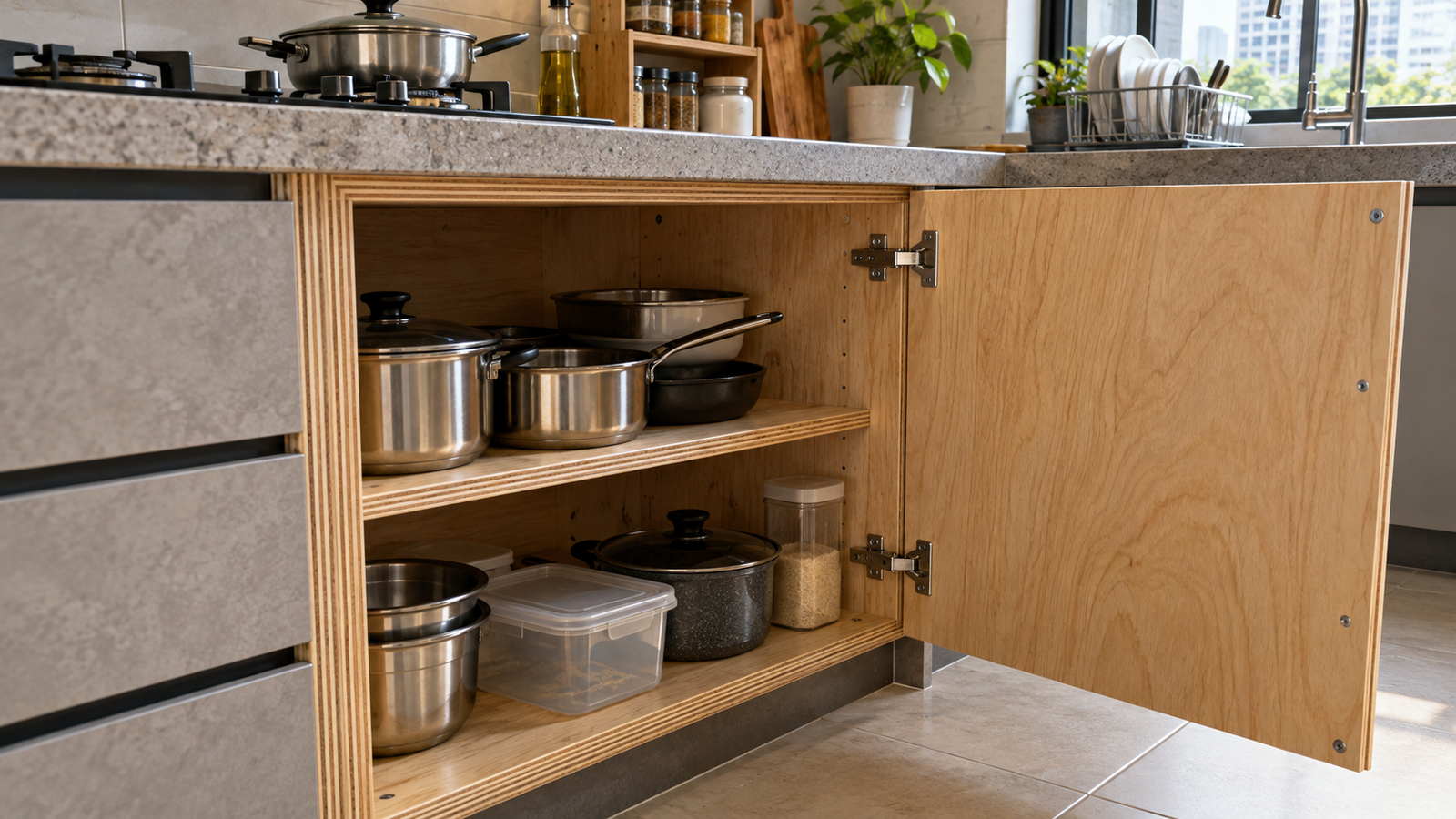
Plywood has been the preferred cabinet carcass material among experienced kitchen designers and quality-focused contractors in Malaysia for decades. Its structural advantages are real, measurable, and particularly relevant in a tropical climate with year-round humidity. Understanding exactly why plywood performs better helps you make an informed decision rather than taking a contractor's word for it.
Plywood's cross-grain lamination is the source of all its structural advantages. Because each ply runs perpendicular to the next, wood movement in one direction is resisted by the neighbouring ply running the other way. This is why plywood does not warp, bow, or split the way solid timber does, and why it retains its shape far better than particleboard under repeated cycles of humidity and drying, which is exactly what a Malaysian kitchen endures every day.
With regard to use in cabinets, it is plywood's ability to hold screws that is the most useful characteristic. Hinges, drawer runners, and shelf pins need screws to be able to hold securely. With plywood, screws actually penetrate into the wood fibres and provide good gripping strength even after multiple assembly and disassembly processes. With particleboard, screws grip into the compressed resin-bonded chips and will eventually strip out over time. Also, the worst case for stripping out is at the edges where particleboard is weaker.
With regard to types of plywood available in Malaysia, the most common one used for making cabinet boxes is structural plywood. Marine plywood has better water resistance, but is much more expensive and is typically used only when the cabinet is in direct contact with water, like a vanity cabinet sitting above a drain in the bathroom floor. For kitchen cabinets, the standard grade of plywood used is structural plywood with a moisture resistant glue line (MR Plywood or Shuttering Plywood).
- Cross-grain construction resists warping in Malaysia's humidity
- Superior screw-holding: hinges and runners stay tight for years
- Handles saw cuts without crumbling or tear-out at edges
- Can be sanded and refinished if surface is damaged
- Structurally sound under heavy loads: pots, plates, appliances
- Repairable without board replacement in most cases
- Retains strength even if surface moisture exposure occurs
- Costs 20 to 40% more than equivalent particleboard
- Heavier, requiring stronger cabinet fixings to the wall
- Interior surface needs melamine lining for a clean finish
- Visible ply edges require edge banding to finish neatly
- Quality varies widely; cheap plywood has voids in inner plies
- Requires more skilled labour to cut and join cleanly
Melamine Particleboard Kitchen Cabinets: A Detailed Look
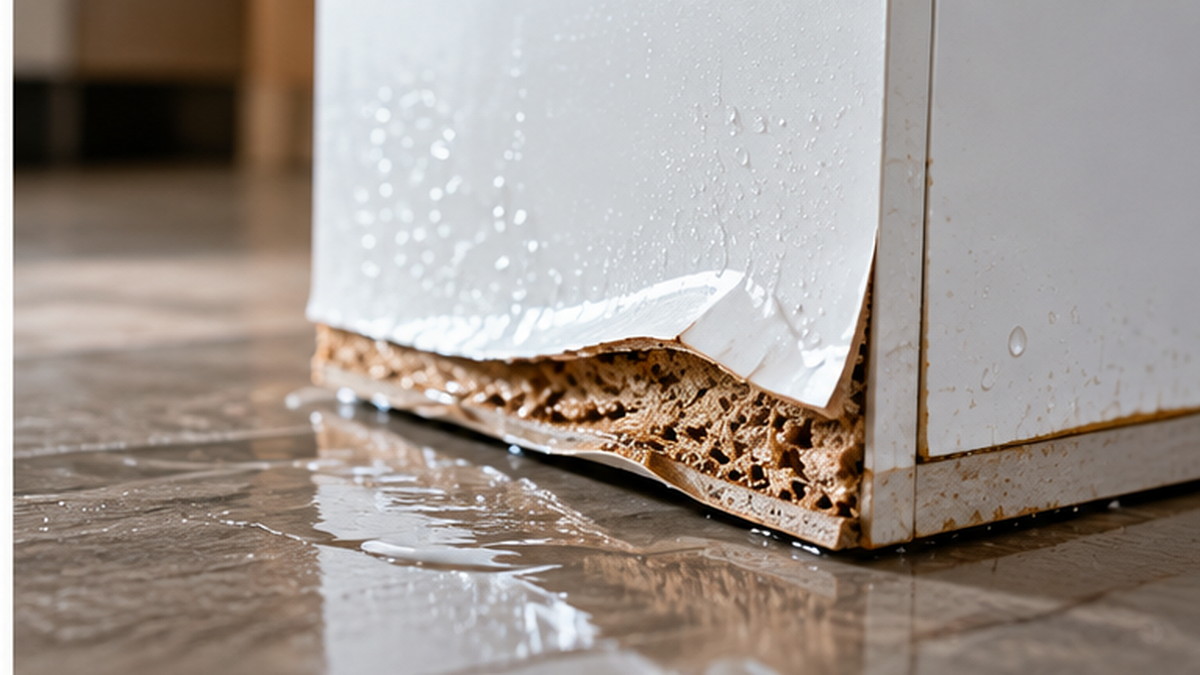
Melamine particleboard is the dominant material in budget-to-mid-range kitchen cabinets across Malaysia, and it is important to understand what it does and does not do well. The criticism particleboard receives is often directed at low-grade board in applications it was never suited for. Used correctly, in the right location, with the right grade and edge treatment, melamine particleboard delivers acceptable performance at a price point that many renovation budgets can realistically afford.
In general, conventional particleboard is highly susceptible to moisture, and this aspect cannot be emphasized enough for Malaysia. The moment any particleboard comes into contact with moisture from its uncoated face, there will be an expansion of the material, leading to its delamination and thus making it structurally defective. For this reason, the quality of particleboard and the edge treatment are two of the most crucial aspects in the assessment of melamine cabinet quotes.
Moisture Resistant (MR) particleboard uses a special resin as a binding material that delays the water absorption process compared to standard particleboard. E1-grade MR board is the minimum acceptable standard for Malaysian kitchen cabinets, particularly for base cabinets near the sink and hob. Look for the E1 mark on the board specification, which also implies a low level of formaldehyde emission. European-certified boards from brands like Egger, Pfleiderer, and Kronospan distributed in Malaysia meet this standard reliably.
Edge banding is the other critical quality indicator. Particleboard edges are the primary entry point for moisture, and the quality of edge banding applied to every cut edge determines how long a melamine cabinet survives in a Malaysian kitchen. The 2mm thick edge banding of ABS plastic using hot melt adhesive and trimmed well is far more moisture-resistant than 0.4mm thin PVC tape commonly used to cut costs. Press the edge banding on any display cabinet, and if it bends or has any gap at the corner, it will absorb moisture.
- Lower upfront cost: 20 to 40% cheaper than plywood
- Factory-smooth surface: no lining needed inside carcass
- Consistent thickness and flatness across the sheet
- Widely available in many thicknesses and finishes
- Adequate for dry kitchen upper cabinets with low load
- Easier to machine and cut on automated CNC equipment
- Swells and delaminates when exposed to moisture or steam
- Screw-holding weakens over time, especially at edges
- Sags under heavy loads, particularly long shelf spans
- Cannot be repaired once swelling or delamination begins
- Poor performance in wet kitchen environments
- Formaldehyde off-gassing risk with low-grade boards
- Edge banding can lift, allowing moisture entry at cut edges
Plywood vs Melamine: Side-by-Side Comparison
The table below compares both materials across every criterion that matters for a Malaysian kitchen. "Win" indicates the stronger performer on each criterion; both materials are noted where performance is genuinely equal.
| Criterion | Plywood | Melamine Particleboard | Winner |
|---|---|---|---|
| Structural strength | High: cross-lamination resists bending and compression | Medium: sags on long spans under heavy loads | Plywood |
| Moisture resistance | High (MR grade): handles steam and humidity well | Low to Medium: MR grade slows but does not stop swelling | Plywood |
| Screw-holding strength | Excellent: holds through repeated tightening cycles | Fair: strips near edges; weakens over time | Plywood |
| Warp and shape stability | Very high: cross-grain resists movement in all directions | Low: prone to bowing in humid conditions | Plywood |
| Wet kitchen suitability | Excellent: recommended for wet kitchen carcasses | Poor to Fair: not recommended for direct steam exposure | Plywood |
| Repairability | Good: screws can be re-drilled, surface refinished | Poor: swelling and stripped screws are rarely repairable | Plywood |
| Upfront cost | Higher: typically 20 to 40% more per cabinet | Lower: baseline market price | Melamine |
| Interior finish | Requires melamine lining for smooth interior | Factory-smooth surface: no additional lining needed | Equal |
| Available finishes (exterior) | All door finishes available: membrane, acrylic, veneer | All door finishes available: membrane, acrylic, veneer | Equal |
| Formaldehyde emission | Lower (E1 or E0 grade common) | Varies: low-grade boards can off-gas more | Plywood |
| Estimated lifespan (Malaysian kitchen) | 15 to 25+ years | 8 to 15 years (dry kitchen) / 5 to 10 years (wet kitchen) | Plywood |
| Cost per year of use | Lower when full lifespan is factored in | Higher once replacement cycle is considered | Plywood |
Why Malaysia's Climate Makes This Decision More Important
Cabinet board decisions that might be marginal in a temperate climate become critical in Malaysia. Year-round humidity, daily high-heat cooking, and the wet-dry kitchen tradition create conditions that stress cabinet materials far harder than a typical European or North American kitchen ever does.
Malaysian kitchens cycle between high-humidity cooking sessions and air-conditioned cool-downs daily. This repeated expansion and contraction is what breaks down particleboard over time: chips and resin separate, leading to the sagging, swelling, and delamination common in older Malaysian kitchens. Plywood's cross-laminated structure resists this cycling because each ply constrains the movement of its neighbours.
Malaysia's wet kitchen sees oil splatter, water splashes, wok hei flames, and continuous steam every day. Base cabinets below the hob and sink endure some of the most punishing conditions any cabinet faces anywhere. Particleboard (even MR grade) was not designed for sustained direct moisture exposure. Plywood is the material that belongs in a Malaysian wet kitchen; the price difference is not a luxury premium but the cost of building something still functional a decade later.
Which Cabinet Material Should You Choose?
The right choice depends on three practical factors: your budget, your kitchen type (wet kitchen, dry kitchen, or both), and how long you intend to stay in the property. Here is a clear framework for each scenario.
Full renovation, planning to stay 10+ years, wet kitchen present. Go with plywood throughout, or at minimum, plywood for all base cabinets and the wet kitchen. The cost difference amortised over 15 to 20 years is negligible compared to re-doing cabinets that have failed from moisture damage.
Full renovation, budget is a constraint, both wet and dry kitchen present. Use a hybrid specification: plywood for all base cabinets where moisture risk and load are highest, and E1 MR melamine for upper wall cabinets where conditions are drier and load is lighter.
No wet cooking, no direct water exposure near cabinets, not planning a 20-year commitment. E1-grade MR melamine with 2mm ABS edge banding is an acceptable option. Inspect cabinets annually near the sink for early signs of edge swelling and address them before moisture penetrates deeper.
Investment property where cost efficiency is the priority and the kitchen will likely be renovated within 8 to 10 years regardless of material performance. Melamine on E1 MR board is the practical choice. Do not compromise on edge banding quality, as poorly sealed edges accelerate cabinet failure significantly.
Plywood is the better material, but melamine is not wrong in the right application
On every structural and durability measure, plywood outperforms melamine particleboard for Malaysian kitchen cabinets. It lasts longer, handles moisture better, holds hardware more securely, and delivers better long-term value once lifespan is factored into the cost comparison. For wet kitchens and for homeowners renovating a long-term home, the case for plywood is clear. That said, quality E1 MR melamine with proper 2mm ABS edge banding is a legitimate and widely used material in Malaysian dry kitchen upper cabinets, and it performs adequately in that lower-stress application. The error is not in choosing melamine for a dry kitchen upper cabinet; it is in using standard or low-grade particleboard for base cabinets near water, or specifying particleboard in a wet kitchen to save cost. That saving reverses within five years.
Questions to Ask Your Kitchen Cabinet Contractor
Most cabinet quotes do not specify board grade, edge banding thickness, or plywood quality in enough detail for you to compare them fairly. Before signing any cabinet order, ask your contractor or supplier the following questions and get the answers in writing as part of the quotation.
The Hybrid Approach: Getting the Best of Both Materials
The most practical and widely recommended approach for Malaysian kitchen cabinets is a hybrid specification: melamine particleboard for cabinet carcasses (the structural box) and plywood for doors, drawer fronts, and high-traffic components. This is not a compromise, it reflects how each material performs best. Understanding the logic behind it helps you verify that your contractor is specifying it correctly.
Melamine particleboard is actually the industry standard for kitchen cabinet carcasses in Malaysia, and for good reason. The sealed melamine surface on the interior of a carcass resists oil splatter, spice stains, and everyday moisture extremely well. The carcass interior rarely sees direct water contact once edge banding is correctly applied, so the material's main vulnerability (exposed cut edges) is managed at the factory. Malaysian kitchen cabinet manufacturers have used melamine carcasses for decades because they are cost-effective, easy to machine with CNC equipment, and perform well in the enclosed interior of a cabinet box.
Where plywood earns its premium is on doors, drawer fronts, and any component that is handled repeatedly, hinged heavily, or exposed to direct heat near the hob. Plywood holds hinges far more securely through thousands of open and close cycles. It resists the heat-related warping that can affect melamine doors in a wet kitchen near a gas wok burner. And it can be refinished if the surface is damaged, extending the lifespan of the visible parts of the kitchen. A hybrid kitchen using melamine carcasses with plywood doors saves around 20% to 30% compared to all-plywood construction while preserving structural strength exactly where it is most visible and most stressed. For a complete look at how material choices interact with cabinet layout and storage planning, see our kitchen storage solutions guide.
Not Sure Which Board Is Right for Your Kitchen?
Our team can advise on the right cabinet specification for your kitchen type, cooking habits, and budget, and show you physical board samples in our showroom before you commit.
Book a Free ConsultationFrequently Asked Questions
Is plywood or melamine better for kitchen cabinets in Malaysia?
Plywood is the stronger and more durable choice for kitchen cabinets, particularly in Malaysia's humid climate. It handles moisture better, holds screws more securely over time, and resists warping more effectively than standard melamine particleboard. However, melamine cabinets built on moisture-resistant (MR) board with proper edge banding offer very good value for money in dry kitchen areas where direct water exposure is not a concern. For wet kitchens and long-term investment, plywood is the better choice.
How long do plywood kitchen cabinets last compared to melamine?
Well-built plywood kitchen cabinets typically last 15 to 25 years or longer with proper care in a Malaysian home. Melamine cabinets on good-quality moisture-resistant particleboard generally last 8 to 15 years in dry kitchen conditions, and may deteriorate faster in wet kitchen environments where steam, humidity, and splashing are constant. The difference in lifespan reflects plywood's superior structural integrity and moisture resistance.
What is the price difference between plywood and melamine kitchen cabinets?
At sheet level in Malaysia (2026), melamine particleboard runs RM80 to RM160 per 4×8ft sheet while furniture-grade plywood costs RM150 to RM250 and marine-grade RM250 to RM350. At the installed cabinet level, an all-melamine specification is typically 30% to 50% cheaper than all-plywood. A hybrid specification, melamine carcasses with plywood doors and drawer fronts, saves around 20% to 30% versus all-plywood while delivering strong structural performance where it is most needed. Plywood finishing (laminate, veneer, or paint) adds a further RM5 to RM15 per square foot to the door cost.
Does melamine board swell or warp in a Malaysian kitchen?
Standard melamine particleboard can swell, delaminate, and warp when exposed to sustained moisture in a Malaysian kitchen environment. The risk is highest near the sink, under the hob where condensation accumulates, and in wet kitchen areas. Moisture-resistant (MR) melamine board significantly reduces but does not eliminate this risk. Plywood is more dimensionally stable and resists repeated cycles of humidity and drying better than particleboard of any grade.
Can you tell the difference between plywood and melamine cabinets by looking at them?
Not from the outside. Both plywood and melamine cabinets use the same range of door finishes including membrane, solid wood veneer, high-gloss acrylic, and PVC wraps. The difference is inside the carcass. The easiest way to check is to look at the exposed edge of a shelf or the cut line inside a cabinet: plywood shows visible layered timber plies; particleboard shows a compressed wood chip and resin core. You can also tell by weight as plywood cabinets feel noticeably heavier.
Which is better for a wet kitchen in Malaysia: plywood or melamine?
Plywood is strongly preferred for Malaysian wet kitchens where high heat, steam, and water splashing are daily realities. Marine-grade or moisture-resistant plywood handles repeated steam and water exposure far better than any grade of particleboard. If budget constraints require melamine board in a wet kitchen, use E1-rated moisture-resistant board and apply aluminium or PVC edge banding on every exposed edge to reduce water ingress. Even so, inspect cabinets near the hob and sink annually for early swelling signs.