Aluminium and melamine sit at opposite ends of the kitchen cabinet decision. One is priced for budget-conscious renovations and offers the widest range of colours and finishes. The other costs more upfront but is engineered to survive exactly the conditions a Malaysian kitchen throws at it: humidity, heat, oil, and steam, day after day.
The question homeowners actually need answered is not which material is objectively better, but which one survives your specific kitchen. A melamine cabinet in a light-use dry kitchen can last for years without issue. The same material installed under a sink in a heavy wok-cooking wet kitchen can start swelling within a year if the edge sealing fails even slightly.
This guide compares aluminium and melamine kitchen cabinets across waterproofing, durability, cost, and long-term maintenance, so you can match the material to how you actually use your kitchen.
- Aluminium is fully waterproof and termite-proof, making it the standard choice for wet kitchens and high-humidity zones
- Melamine is more affordable and offers a wider colour range, but its particleboard core absorbs moisture if edge sealing fails
- Aluminium typically costs from RM500 per linear foot; melamine typically ranges RM150 to RM250 per linear foot
- The weakest point of any melamine cabinet is the edge banding — once water penetrates a compromised edge, the board swells permanently
- Most Malaysian kitchens benefit from a mixed approach: aluminium near the sink and wet zone, melamine or laminate elsewhere
Aluminium vs Melamine: Quick Comparison
| Factor | Aluminium | Melamine |
|---|---|---|
| Waterproofing | Fully waterproof, does not absorb moisture | Core absorbs moisture if edge sealing fails |
| Termite resistance | Completely termite-proof | Resistant coating, but core is vulnerable if damaged |
| Heat resistance | Excellent, unaffected by stovetop heat | Good, but prolonged heat can damage the coating |
| Cost per linear foot | From RM500/ft and up | RM150 to RM250/ft |
| Lifespan | 15+ years with minimal degradation | 5 to 10 years, shorter if wet zone edges are poorly sealed |
| Maintenance | Wipe clean, no special care needed | Wipe clean, avoid prolonged moisture |
| Aesthetic range | Sleek, modern, metallic finish | Wide colour and texture range |
| Best suited for | Wet kitchens, heavy daily cooking | Dry kitchens, light use, budget renovations |
What Is an Aluminium Kitchen Cabinet?
Aluminium kitchen cabinets use an aluminium frame or full aluminium carcass instead of a wood-based board. Because aluminium does not absorb moisture, it does not swell, warp, or rot, regardless of how much water, steam, or oil exposure it faces over time.
- Completely waterproof — does not absorb moisture under any condition
- Fully termite-proof, no wood-based material for termites to target
- Highly heat-resistant, unaffected by stovetop heat or steam
- Long lifespan, often outperforming wood-based alternatives by a decade or more
- Recyclable material with better long-term sustainability
- Higher upfront cost compared to melamine or standard laminate
- More limited colour range, though modern powder-coated finishes are expanding options
- Requires precise fabrication — poor welding or joinery affects long-term stability
What Is a Melamine Kitchen Cabinet?
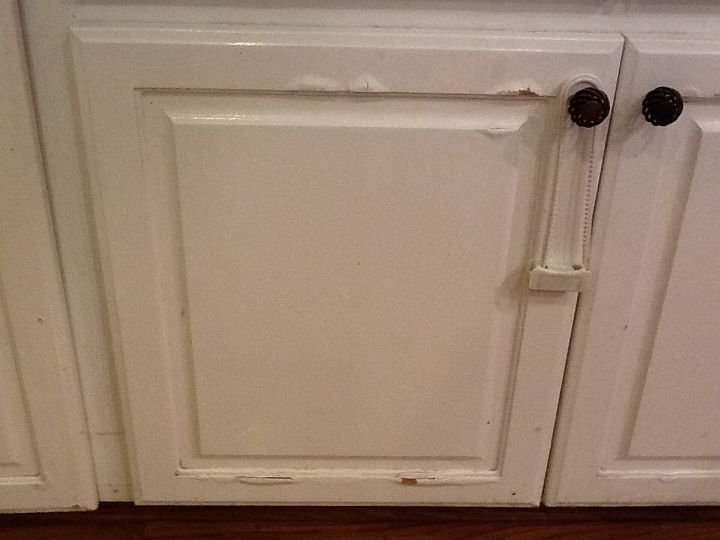
Melamine kitchen cabinets use a particleboard or chipboard core finished with a melamine-faced surface. It is one of the most common cabinet materials in Malaysia because it is budget-friendly, comes in an extensive range of colours and finishes, and is straightforward to clean.
- Significantly more affordable — typically RM150 to RM250 per linear foot
- Widest colour and finish range among common cabinet materials
- Easy to clean with a damp cloth and mild detergent
- Suitable for dry kitchens and light-use spaces without issue
- Particleboard core absorbs moisture like a sponge if edge sealing fails
- Once swollen from water exposure, the panel cannot be repaired, only replaced
- More prone to chipping and cracking compared to aluminium
- Formaldehyde emissions vary by grade — E1 boards emit far less than E2
Waterproofing and Durability: What Actually Happens Over Time
The single biggest factor separating these two materials in a Malaysian kitchen is what happens when water gets involved, which in a kitchen is not a matter of if but when.
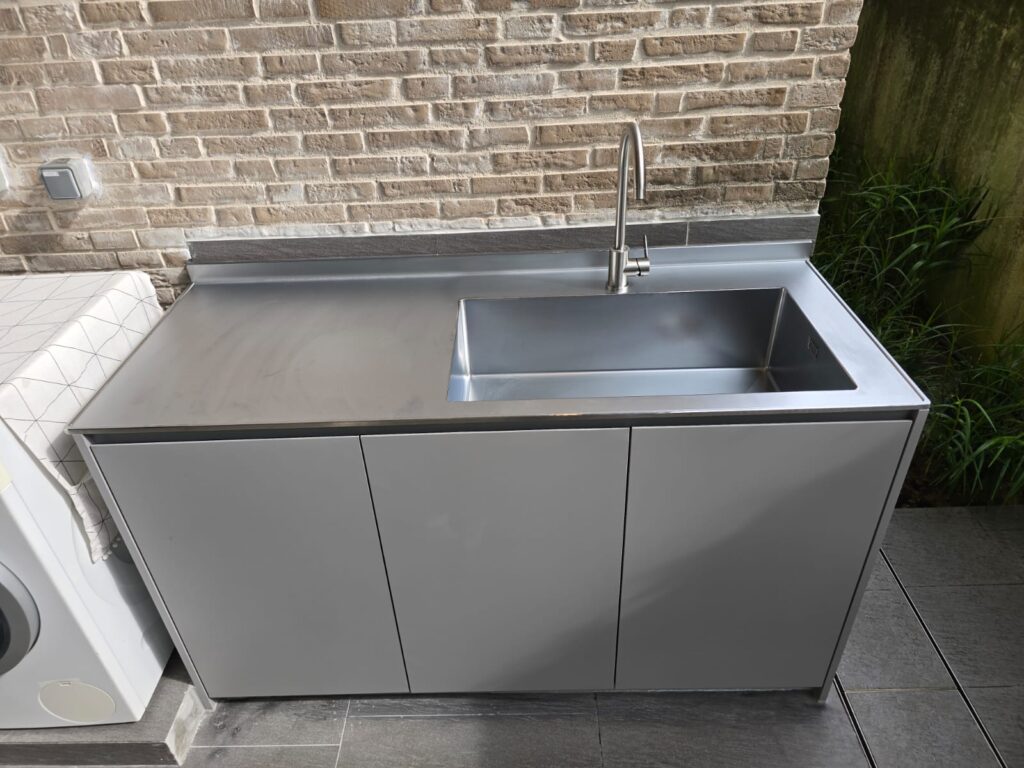
Aluminium Under Water Exposure
Because aluminium does not absorb moisture at all, there is no degradation process to describe. Water splashes, steam, and even direct exposure near a sink have no structural effect on an aluminium carcass or frame. This is why aluminium is the default recommendation for wet kitchen zones in Malaysia, where wok cooking, boiling, and constant water use are part of daily life.
Melamine Under Water Exposure
Standard melamine boards use a particleboard core that behaves like a sponge once water penetrates the surface. The weakest point is always the edge banding, the thin strip sealing the raw edge of the board. If this edge is poorly applied or begins to lift over time, water from a wiped countertop or steam from a rice cooker can seep in.
Once moisture reaches the particleboard core, the board swells and the damage is permanent. There is no repair that restores a swollen panel; the affected cabinet section has to be replaced entirely.
Cost Comparison: Aluminium vs Melamine
Material cost is measured per linear (running) foot of cabinet, covering the carcass and door but not countertop, hardware, or installation.
| Material | Typical Price Range | Notes |
|---|---|---|
| Melamine | RM150 – RM250 / ft | Entry-level pricing; upgraded HMR boards cost slightly more |
| Aluminium | RM500 / ft and up | Higher upfront cost, offset by significantly longer lifespan |
For a full pricing breakdown across all cabinet materials, including plywood, acrylic, and solid wood, read our comprehensive kitchen cabinet price guide for Malaysia.
Which Material Suits Your Kitchen Zone?

Many Malaysian kitchens do not need to choose one material exclusively. The most cost-effective and durable approach is often to match the material to the specific zone.
- Wet Kitchen or Sink Area Aluminium is the clear choice. This zone faces daily water exposure, splashing, and steam — exactly the conditions melamine struggles with long term.
- Dry Kitchen or Display Cabinets Melamine performs well here. Without regular water exposure, the swelling risk drops significantly, and the wider colour range lets you achieve a more personalised look for less.
- High-Frequency Wok Cooking Households Aluminium across the full kitchen is worth the investment, given the volume of oil, heat, and steam generated daily.
- Light-Use or Rental Kitchens Melamine is a sound, cost-effective choice, provided the edge sealing is done properly by an experienced installer.
If you are planning a full wet and dry kitchen split for a landed home, our kitchen layout guide for landed homes covers exactly how material choice should differ between the two zones.
Which Should You Choose?
| Your Situation | Recommended Material |
|---|---|
| Wet kitchen, daily heavy cooking | Aluminium |
| Dry kitchen or display area | Melamine (or upgraded HMR board) |
| Rental property, budget-conscious | Melamine with proper edge sealing |
| Long-term home, investing for durability | Aluminium, at least in the wet zone |
| Mixed wet and dry layout | Aluminium in wet zone, melamine in dry zone |
Why Choose EverKitchen for Your Cabinet Material Selection
EverKitchen has completed more than 10,000 kitchen projects across Malaysia, working with both aluminium and melamine cabinetry across condos, terrace houses, and landed homes. Our team will assess your kitchen's specific conditions, cooking habits, and budget to recommend the material that actually fits, not the one that is easiest to sell.
Compare Materials with a Free Consultation
See aluminium and melamine samples side by side and get an itemised quotation for your kitchen.
View Kitchen Cabinet PackagesFrequently Asked Questions
Is aluminium or melamine better for a Malaysian kitchen?
It depends on the zone and how often you cook. Aluminium is fully waterproof and termite-proof, making it the better choice for wet kitchens and daily heavy cooking. Melamine is more affordable and works well for dry kitchens or light-use spaces, provided the edge sealing is done properly.
How much does aluminium kitchen cabinet cost compared to melamine in Malaysia?
Aluminium typically starts from RM500 per linear foot, while melamine typically ranges from RM150 to RM250 per linear foot. Aluminium costs more upfront but offers a significantly longer lifespan.
Can melamine cabinets be waterproof?
Standard melamine is not fully waterproof, since the particleboard core absorbs moisture if the edge sealing fails. Requesting HMR (High Moisture Resistant) board or V313-certified moisture-resistant chipboard improves water resistance, though it still will not match aluminium's complete waterproofing.
What happens if water gets into a melamine cabinet?
Once moisture penetrates the particleboard core, usually through a compromised edge, the board swells permanently. There is no repair that restores a swollen panel — the affected section must be replaced entirely.
Do aluminium kitchen cabinets get affected by termites?
No. Aluminium is completely termite-proof since there is no wood-based material for termites to target, making it a genuine long-term solution in termite-prone areas.
Can I mix aluminium and melamine cabinets in the same kitchen?
Yes, and this is a common and cost-effective approach. Many Malaysian homeowners use aluminium in the wet kitchen or sink zone and melamine elsewhere, balancing durability with budget.